 By Karan Singh
 There’s a temple near Vijayawada where devotees pour jaggery water straight into a deity’s open mouth — and exactly half of it gets consumed while the rest flows back out as prasadam, accompanied by a genuine gurgling sound. This isn’t folklore exaggeration; it’s the daily reality at Panakala Narasimha Swamy Temple, perched on an elephant-shaped hill that legend says was once a prince who transformed himself to become Lord Vishnu’s eternal abode. If you’re planning a visit specifically to witness this rare Panakam ritual, timing genuinely matters here — the temple closes by mid-afternoon, unlike most South Indian shrines with a full evening session. Here’s everything sorted before you go.
Quick Overview
| Detail | Information |
| Temple | Sri Panakala Narasimha Swamy Temple (Hilltop) |
| Deity | Lord Narasimha (Swayambhu, mouth-only form) |
| Location | Mangalagiri Hill, Guntur District, Andhra Pradesh – 522503 |
| Daily Timings | 7:00 AM – 3:00 PM (no evening session) |
| Panakam Offering Window | 7:30 AM – 1:00 PM |
| General Darshan Fee | Free |
| Special/Seegra Darshan | ₹100 |
| Distance from Vijayawada | ~12 km |
Temple Timings: A Rare Morning-Only Schedule
Panakala Narasimha Swamy Temple genuinely stands apart from most Andhra Pradesh temples by operating on a single daily session rather than the typical morning-evening split. Doors open at 7:00 AM, followed by Morning Archana from 7:00 to 7:30 AM. The main window for devotees — Special Archana and the Panakam offering — runs from 7:30 AM to 1:00 PM. Maharnivedana (the main food offering to the deity) happens at 1:00 PM, and the temple closes its doors for the day around 3:00 PM.
This means there’s no evening darshan option here, unlike the separate Lakshmi Narasimha Swamy Temple at the foot of the hill, which stays open considerably later. If you’re specifically visiting Panakala Swamy on the hilltop, plan your trip for the morning — arriving in the afternoon after 3:00 PM means finding the doors already shut for the day.
Nijaroopa Darshan, a special viewing of the deity in an uncovered, unadorned form, happens at 6:00 AM specifically on every Ekadasi day — a genuinely rare opportunity most casual visitors don’t know to plan around.
Best time for a peaceful visit: Early morning, right after the 7:00 AM opening, offers the calmest atmosphere before the Panakam offering crowd builds. Weekends and festival days see noticeably heavier footfall, so weekday mornings are your best bet for a quick, unhurried darshan — most visits last only 15 to 30 minutes given the temple’s compact scale.
The Panakam Miracle: What Actually Happens
This is genuinely the reason most people travel here, and it’s worth understanding before you arrive. Unlike a conventional idol, the Swayambhu (self-manifested) deity at Panakala Swamy appears only as a face with a widely open mouth — no full body form is visible.
Devotees pour Panakam (jaggery water) directly into this open mouth as an offering. According to consistent temple tradition, exactly half the liquid gets consumed by the deity, while the remaining half flows back out as prasadam, accompanied by an audible gurgling sound during the process. Remarkably, despite the sheer volume of sweet liquid offered daily, no ants or flies are found anywhere near the temple — a detail devotees and temple authorities alike point to as part of the site’s enduring mystery.
According to temple tradition tied to the four yugas, honey was offered to the Lord during Krita Yuga, ghee during Dwapara Yuga, milk during Treta Yuga, and jaggery water (Panakam) in the current Kali Yuga — making this offering method specific to our present age.
Darshan and Seva Pricing
General darshan remains free, and this is how most pilgrims experience the temple, joining the queue for the Panakam ritual during the 7:30 AM to 1:00 PM window.
For faster access, Special Darshan (Seegra Darshanam) costs ₹100 per person. The Panakam Offering itself, when purchased as a specific ticketed ritual, costs just ₹10.
Beyond these, the temple offers an extensive range of sevas:
- Sahasranamarchana — ₹200
- Daily Gotra Naamarchana (yearly) — ₹516
- Shanti Kalyanam — ₹1,500
- Tiruvanjanam (Ekadashi/Swati) — ₹1,116
- Tiruvanjanam (Ammavaru Friday) — ₹1,116
- Sudarshan/Narasimha/Lakshmi Homam — ₹3,500
- Golden Garuda Seva (Pournami) — ₹5,000
- Sheshavahana Seva — ₹5,000
Booking process: These sevas can be arranged through the official temple website (panakalanarasimhaswamy.org) or directly at temple counters. Given the temple’s brief single-session schedule, it’s genuinely worth confirming seva timing slots in advance rather than assuming walk-in availability, particularly for higher-tier sevas like Golden Garuda Seva that likely have limited daily capacity.
The Legend Behind the Elephant-Shaped Hill
Understanding Mangalagiri Hill’s origin story genuinely enriches the visit. According to legend, Hrasva Srungi, son of King Pariyatra, traveled to sacred sites seeking to regain his normal bodily form after a curse, eventually arriving at this location. The Devas advised him to remain here and continue penance in devotion to Lord Vishnu. When his father arrived with an entourage to bring him back to the kingdom, Hrasva Srungi instead transformed himself into an elephant to become the eternal abode of Lord Vishnu — worshipped since as Panakala Lakshmi Narasimha Swamy.
This is precisely why Mangalagiri Hill appears elephant-shaped from every direction you view it — a detail locals and pilgrims alike point out as part of the site’s mystique. A separate tradition also holds that Lord Narasimha specifically calmed his fierce anger here after defeating the demon Namuchi, choosing this hill as a place of peace.
Mangalagiri is counted among the eight Mahakshetrams in India where Lord Vishnu is believed to have manifested himself, alongside Sri Rangam, Srimushnam, Naimisam, Pushkaram, Salagramadri, Narayanasramam, and Venkatadri.
Historical Markers Worth Noticing on the Climb
As you climb the steps toward the hilltop temple, look for a stone inscription attributed to Krishnadeva Raya of the Vijayanagara Empire, documenting land grants across nearby villages including Mangalagiri itself. A little further up, you’ll find footprints believed to belong to the saint Chaitanya Mahaprabhu — a detail many visitors walk right past without realizing its significance.
The steps themselves were constructed by Sri Channapragada Balaramadasu in 1890, and a dhwajasthambham (flagpost) was erected in front of the temple in 1955. Behind the main shrine sits a temple dedicated to Goddess Lakshmi, near a tunnel that local tradition claims once connected to the Undavalli Caves on the banks of the Krishna River, though the passage is no longer navigable today.
The Companion Temple: Lakshmi Narasimha Swamy at the Foot of the Hill
Most pilgrims combine their hilltop Panakam darshan with a visit to Lakshmi Narasimha Swamy Temple, located right at the base of Mangalagiri Hill. This temple runs a considerably longer daily schedule — generally 4:00/5:00 AM to 1:00 PM, and again from 4:00 PM to 8:30/9:00 PM — giving you more flexibility if your Panakala Swamy visit runs early.
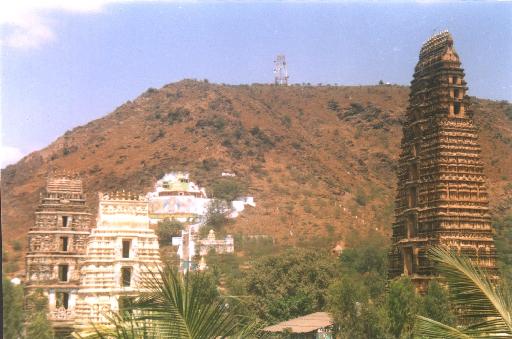
According to tradition, the main deity here was installed by Yudhishthira, the eldest of the Pandavas. The temple’s standout architectural feature is its 153-foot, 11-story gopuram, built by Raja Vasireddy Venkatadri Naidu between 1807 and 1809 — one of the tallest temple towers in South India, and the structure most visitors photograph before heading up the hill.
Dress Code and Practical Rules
Any decent, respectful outfit is generally acceptable at both temples — the dress code here is notably less strict than at some other major Andhra Pradesh shrines.
Photography is not permitted inside the hilltop Panakala Swamy Temple, so plan to capture the elephant-shaped hill and surrounding views before or after entering the sanctum area.
Brahmotsavam, held annually in February or March, is the temple’s grandest festival, drawing lakhs of devotees over several days — worth attending if you want the full festive atmosphere, though expect considerably longer queues than a regular visit.
Location: Where Exactly Is the Temple?
Panakala Narasimha Swamy Temple sits atop Mangalagiri Hill in Guntur District, Andhra Pradesh, roughly 12 km from Vijayawada. Mangalagiri itself is also known for its handloom cotton, so a visit here pairs naturally with a bit of local textile shopping alongside the pilgrimage.
How to Reach Panakala Swamy Temple
By Air
Vijayawada Airport is the nearest, roughly 35 km from the temple, with taxis readily available for the onward journey.
By Rail
Vijayawada Railway Station is close by, roughly 12 km away, making it the most convenient rail gateway. Guntur Railway Station is another option, about 21 km from the temple, with direct trains connecting Guntur to major cities across India.
By Road
Regular buses run from Vijayawada, covering the roughly 13 km distance to Mangalagiri. Taxis and private vehicles are also easily available given the temple’s proximity to a major city.
Climbing the hill: Elderly visitors or those with mobility concerns should note that reaching the hilltop temple does involve a genuine flight of steps — there’s no elevator or vehicle access to the summit shrine, so factor this into your planning if you’re traveling with senior family members.
Frequently Asked Questions
Q1. We’re planning to arrive around 2 PM — will we still catch the Panakam offering?
Likely not the full ritual experience, since the main Panakam offering window runs from 7:30 AM to 1:00 PM, with the temple closing entirely by around 3:00 PM. Plan your visit for the morning instead, ideally arriving by 9:00 or 10:00 AM to comfortably participate before the window closes.
Q2. Is it worth visiting on Ekadasi specifically for the Nijaroopa Darshan?
Yes, if witnessing the deity’s uncovered, unadorned form genuinely interests you — this special 6:00 AM darshan happens only on Ekadasi days and isn’t available during regular visits. Just be prepared for a considerably earlier start and likely heavier crowds given how spiritually significant this specific viewing is to regular devotees.
Q3. We have elderly parents who can’t manage a hill climb — should we skip Panakala Swamy entirely?
Not necessarily. While the hilltop Panakala Narasimha Swamy Temple does require climbing steps with no vehicle access to the summit, you can still have a complete darshan experience at the Lakshmi Narasimha Swamy Temple at the foot of the hill, which is fully accessible and runs a longer daily schedule. Many families split their visit this way, with only some members making the hilltop climb.
Q4. Can we combine this with other Vijayawada attractions in a single day trip?
Yes, given Mangalagiri’s roughly 12 km proximity to Vijayawada, this pairs naturally with other city attractions like Kanaka Durga Temple or Undavalli Caves. Plan your Panakala Swamy visit for early morning given its limited hours, then continue on to other sites once you’ve completed darshan before the temple’s mid-afternoon closure.