 By Karan Singh
 Just past Ramoji Film City, on a peaceful hillock called Paramananda Giri, sits a temple that many Hyderabadis treat as their own mini-Tirumala — without the days-long queue. Sanghi Temple isn’t ancient, and it doesn’t claim to be; it was built in 1991 by a well-known Hyderabad business family specifically to give devotees a Tirumala-style darshan experience closer to home. That practical origin story is exactly why it works so well as a weekend spiritual getaway. If you’re planning a visit, here’s everything you need to know before making the drive out.
Quick Overview
| Detail | Information |
| Temple | Sanghi Temple (Sri Venkateswara Temple) |
| Deity | Lord Venkateswara (replica of the Tirumala idol) |
| Location | Sanghi Nagar, Omerkhan Daira, near Ramoji Film City, Hyderabad |
| Weekday Timings (Mon–Sat) | 8:00 AM – 1:00 PM, 4:00 PM – 8:00 PM |
| Sunday/Festival Timings | 8:00 AM – 8:00 PM (continuous) |
| Entry Fee | Free |
| Parking | ₹20–40 (cars/two-wheelers) |
| Distance from Hyderabad | ~25–35 km |
Temple Timings: Weekday vs Sunday Schedule
Sanghi Temple runs a two-session schedule on regular weekdays — Monday through Saturday — opening at 8:00 AM and continuing until 1:00 PM, followed by an afternoon closure before evening darshan resumes at 4:00 PM and runs until 8:00 PM.
Sundays, festivals, and public holidays work differently: the temple stays open continuously from 8:00 AM to 8:00 PM without the midday break, which genuinely helps if you’re planning a weekend family trip and don’t want your visit interrupted by a closure.
Evening Aarti typically runs between 6:00 PM and 8:00 PM, and this is genuinely worth timing your visit around — several longtime visitors specifically recommend catching the temple lit up in the evening, describing the illuminated white marble structure against the night sky as one of the most memorable parts of the whole trip.
Best time for a peaceful visit: Early morning right after the 8:00 AM opening sees noticeably lighter crowds than later in the day, and the cooler hillock air makes the climb up to the summit genuinely more pleasant. If you’re visiting specifically to avoid crowds, weekdays outside festival periods are your best bet — weekends can get busy enough that one visitor described it as feeling like “the entire Hyderabad had come to visit.”
Darshan: Free Entry with Optional Special Poojas
General darshan at Sanghi Temple is completely free, and this is genuinely how most visitors experience the temple — no ticket, no advance booking required for standard darshan.
For those wanting a more personal ritual experience, the temple offers special poojas including Archana and Abhishekam, particularly during festival periods, with pricing varying by the specific ritual chosen. Durga Pooja specifically takes place every Tuesday and Friday, worth knowing if you’re hoping to time your visit around this.
VIP darshan is available at some sources’ mention as an online-bookable option to skip queues during busy periods, though this isn’t consistently confirmed across all sources as a standing feature — it’s worth checking current availability directly at the temple or its official site if a faster queue matters to your visit, particularly during major festivals.
Understanding the Temple’s Origin and Architecture
This is genuinely what makes Sanghi Temple’s story different from most South Indian pilgrimage sites you’ll read about. Rather than tracing back centuries, the temple was conceived and built by the Sanghi Group, a well-known Hyderabad-based business family recognized for their philanthropic work, with construction completed in just 18 months during 1991.
Their specific goal was creating a spiritually accessible sanctuary reflecting the grandeur of Tirumala’s Venkateswara Temple, without requiring devotees to travel all the way to Andhra Pradesh. The presiding deity, standing roughly 9.5 to 9.6 feet tall, is deliberately crafted to resemble the sacred idol at Tirumala — a detail many devotees specifically seek out, treating a Sanghi Temple visit almost as a local equivalent to the famous hill shrine.
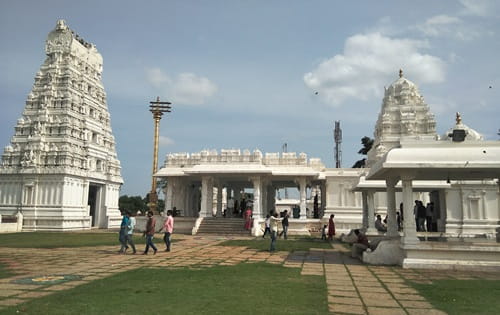
The complex is built entirely of white marble in Chola-Chalukya architectural style, with clear influences from Pallava and Chola temple traditions visible in the intricately carved gopurams and symmetrical mandapams. The Raja Gopuram, the main entrance tower, rises 15 feet and is visible from several kilometres away, while the Vimanam (tower over the sanctum) stands 32 feet tall.
What You’ll Find Inside the Temple Complex
Beyond the main Venkateswara shrine, Sanghi Temple houses a genuinely comprehensive collection of deities within a single complex — Padmavati, Shiva (paired with Goddess Kamalambika), Rama, Ganesha, the Navagrahas, Goddess Ashtalakshmi, Durga, Kartikeya, and Parvati all have dedicated shrines here. A separate Sri Anjaneya Temple sits at the base of the hill, distinct from the main summit complex.
This range of deities within one location is genuinely one of the temple’s biggest practical draws — devotees can complete what feels like a fuller spiritual circuit without traveling to multiple separate temples across the city.
The complex also includes a Pavitra Vanam (sacred garden), where special leaves and flowers used specifically for temple poojas are cultivated on-site — a detail that reflects the thoughtful, almost self-sufficient design behind the entire temple.
Reaching the summit: A series of steps leads up to the main temple, with stone elephant heads forming the bannisters along the way — a distinctive visual detail worth noticing as you climb, alongside the massive, ornately carved entrance door at the Maha Dwaram.
Practical Facilities and Dress Code
The temple provides genuinely solid visitor amenities: clean restrooms for men and women, multiple drinking water stations, and an on-site canteen serving simple vegetarian meals and prasadam — useful if you’re planning to spend a good part of the day there.
Dress code: Traditional attire is recommended out of respect for the temple’s religious sanctity. Footwear must be removed before entering, following standard South Indian temple custom.
Photography is generally permitted within the temple premises, though it’s worth being mindful of any specific restrictions posted near the inner sanctum areas.
Parking: Ample space is available for both cars and buses, with charges ranging from ₹20 to ₹40 depending on vehicle type.
Festivals Worth Planning Around
Sanghi Temple celebrates a full calendar of Hindu festivals with genuine enthusiasm, including Shivaratri, Sri Rama Navami, Krishnashtami, Vinayaka Chaturthi, Dussehra, Hanuman Jayanthi, and Brahmotsavams. The temple also sees exceptionally heavy footfall specifically on Ekadashi and New Year’s Day, when lakhs of devotees make the trip — worth avoiding if a quieter visit is your priority, or worth embracing if you want to experience the temple at its most vibrant.
Location: Where Exactly Is the Temple?
Sanghi Temple sits atop Paramananda Giri hill in Sanghi Nagar, Omerkhan Daira, roughly 25 to 35 km from central Hyderabad depending on your exact starting point, and just about 5 km from Ramoji Film City — making the two a natural pairing for a full day out. Its elevated hillside position offers genuinely scenic panoramic views of the surrounding countryside, adding a peaceful, almost retreat-like quality that distinguishes it from busier city temples.
How to Reach Sanghi Temple
By Rail
Nampally Railway Station is roughly 25 km from the temple. From the station, autos or cabs cover the remaining distance.
By Metro
LB Nagar Metro Station serves as the nearest metro connection, with distances cited between 11 and 25 km depending on the exact route measured — from there, an auto or cab completes the journey.
By Air
Hyderabad’s Rajiv Gandhi International Airport sits approximately 36 km from the temple, with taxis readily available for the drive.
By Road
TSRTC buses heading toward the Vijayawada Highway pass near Sanghi Nagar, with the local Sanghi Nagar bus stop just about a 2-minute walk from the temple itself. Given the somewhat limited frequency of public buses on this route, most visitors find hiring a taxi or driving their own vehicle genuinely more convenient, especially if combining the trip with Ramoji Film City.
Frequently Asked Questions
Q1. We’re traveling with elderly parents in their 70s — is there any way to reach the temple without climbing all the steps?
Based on visitor inquiries, this is a common concern, and while some ask specifically about lift access, the standard route to the summit does involve a series of steps with stone elephant-head bannisters. It’s worth calling the temple directly beforehand to confirm current accessibility options or any vehicle access closer to the summit for elderly or mobility-limited visitors, since this can vary and isn’t consistently documented online.
Q2. We want to combine this with Ramoji Film City in a single day — how should we sequence our visit?
Given the temple’s roughly 5 km proximity to Ramoji Film City, many visitors do exactly this. A sensible approach is completing morning darshan at Sanghi Temple before 1:00 PM (avoiding the midday closure), then heading to Ramoji Film City for the afternoon and evening, since the film city typically has its own extended operating hours better suited to a longer visit.
Q3. Is the ₹10-40 parking fee the only cost involved, or should we budget for anything else?
For a standard darshan visit, parking and any voluntary donations are genuinely the only costs most visitors incur, since general entry remains free. If you’re planning to participate in specific rituals like Archana or Abhishekam, particularly during festivals, budget separately for those, as pricing varies by the specific seva chosen.
Q4. We’re visiting specifically for the evening Aarti — what time should we plan to arrive to get a good spot?
Since evening Aarti typically runs between 6:00 PM and 8:00 PM, arriving by 5:30 PM gives you a comfortable buffer to find a good viewing spot, especially on weekends when the evening session draws noticeably larger crowds than daytime visits. This timing also lets you experience the temple’s illuminated night appearance, which many longtime visitors consider genuinely worth the trip on its own.