 By Karan Singh
 If you’ve already read about Swamimalai’s basic timings and travel logistics, this piece goes deeper into what actually makes this temple spiritually distinct. Most guides tell you when the gates open. Far fewer explain why Swamimalai occupies such a unique place among the six Arupadai Veedu shrines, what its rituals actually mean, or how it fits into a broader Murugan pilgrimage across Tamil Nadu. Understanding these layers changes how you experience the temple — and helps you plan a visit around what genuinely matters to you, rather than just ticking off another stop on a temple-hopping itinerary.
Why Swamimalai Is Different From Every Other Murugan Temple
Most Murugan shrines emphasize his role as a warrior god — the one who defeated Surapadman, the fierce protector wielding the Vel. Swamimalai flips that entirely. Here, Murugan is worshipped as the teacher, the one who instructed his own father, Lord Shiva, in the meaning of the Pranava mantra “Om.”
The legend behind this is genuinely striking. When Lord Brahma failed to properly explain the sacred syllable’s meaning, young Murugan imprisoned him and briefly took over the role of creation himself. With Brahma detained, all of creation reportedly ground to a halt, and the devas pleaded with Shiva to intervene. Shiva approached his son, and Murugan agreed to release Brahma and reveal the mantra’s true meaning — but only if Shiva himself accepted him as Guru and listened as a devoted disciple. Shiva did exactly that, and the site where this exchange happened became known as Swamimalai, with Murugan honored here as Swaminatha, “Lord of even the Lord.”
This is precisely why Swamimalai draws a different kind of devotee than temples like Palani or Tiruchendur. Students preparing for exams, professionals facing career decisions, and families seeking clarity in major life choices specifically travel here, treating the temple as a place of wisdom-seeking rather than a request for protection or victory.
The 60 Steps: More Than Just a Climb
Every Arupadai Veedu temple has its own physical signature — Palani has its famous 693 steps, and Swamimalai has 60. But these steps aren’t simply architectural; they’re symbolic in a way that adds genuine meaning to the climb.
Each of the 60 steps represents one of the 60 years in the traditional Tamil calendar cycle. The first 30 steps lead to the temple’s second enclosure, and the remaining 30 carry devotees to the summit sanctum. On Tamil and English New Year days specifically, the temple conducts Padi Puja — a ritual worship dedicated to these steps themselves, complete with coconuts, fruits, and devotional hymns, treating the staircase almost as a living representation of time itself.
Local tradition holds these steps in a regard comparable to the sanctity of Sabarimala’s 18 steps, which gives you a sense of how seriously this symbolism is taken by regular devotees, even though the climb itself is far shorter and more manageable than Sabarimala’s famously demanding trek.
The White Elephant: A Detail Most Visitors Miss
Walk into almost any other Murugan temple, and you’ll find a peacock positioned in front of the deity — it’s practically a visual signature of Murugan worship across South India. Swamimalai breaks this pattern entirely with a white elephant, Airavata, standing before the sanctum instead.
According to temple tradition, Lord Indra gifted this elephant to Murugan specifically after receiving spiritual instruction from him — a detail that ties directly back into the temple’s core identity as a place of teaching and wisdom rather than conquest. If you’re visiting primarily to photograph or understand the temple’s iconography, this is genuinely one of the details worth pausing at rather than rushing past.
Understanding the Temple’s Layered Architecture
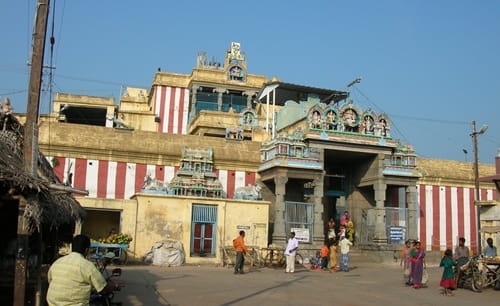
Swamimalai’s structure isn’t a single sanctum you walk straight into — it’s built across three distinct enclosures on what’s called a “Kattu Malai,” an artificial hill, since the Thanjavur region has no natural hills of its own.
The first enclosure sits at the base and houses images of Dakshinamurthy, Durga, Chandikeswarar, and the festival representation of Swaminathaswamy, along with a Vinayagar shrine just outside. The second enclosure sits midway up, reached after the first 30 steps. The third and final enclosure, at the summit, houses the central shrine — a six-foot granite statue of Swaminathar adorned in golden armor, crowns, and a diamond-tipped weapon.
Interestingly, shrines dedicated to Murugan’s parents, Meenakshi (Parvati) and Sundareswarar (Shiva), sit further down the hill rather than within the main summit complex — a layout that some devotees interpret as reflecting the temple’s core legend, where the son ascended to a position of spiritual authority even the father honored.
The Diamond Vel: Why Thursdays Are Special Here
Regular devotees know that Thursday carries particular significance at Swamimalai — this is the day the deity is adorned with a Diamond Vel, the sacred spear associated with Murugan. Many pilgrims specifically time their visits around this weekly ritual, treating it as a heightened darshan experience distinct from any other day of the week.
If your visit isn’t tied to a specific date and you have flexibility, building your trip around a Thursday genuinely adds a layer most casual visitors never witness.
Festival Calendar: Choosing the Right Time for Your Visit
Swamimalai’s festival calendar offers genuinely distinct experiences depending on what you’re seeking:
Tirukarthikai (November/December) stands as the temple’s most significant annual event — a ten-day celebration drawing lakhs of devotees, generally considered the single biggest occasion in the temple’s yearly calendar.
Vaikasi Visakam (May/June) features the grand Rathotsavam, or car festival, where the temple’s presence extends beyond the hill itself into the surrounding streets.
Panguni Uthiram and Panguni Valli Parinayam (March) celebrate aspects of Murugan’s marriage traditions, while Thai Poosam (February) brings the kavadi processions and devotional intensity associated with Murugan worship across Tamil Nadu more broadly.
Chithirai Brahmotsavam (March/April) and Aavani Pavithrotsavam (August/September) round out the year with their own distinct rituals, alongside Navaratri celebrations in September/October.
Each of these carries a different atmosphere — Tirukarthikai and Vaikasi Visakam for those wanting the full grandeur and crowd energy, versus a quiet weekday visit for those seeking the contemplative, teaching-focused character the temple is genuinely known for.
Placing Swamimalai Within the Arupadai Veedu Circuit
Swamimalai holds the fourth position among the six Arupadai Veedu shrines, alongside Thiruparankundram, Thiruchendur, Palani, Thiruthani, and Pazhamudhircholai. For devotees attempting the full six-temple pilgrimage, understanding each shrine’s distinct character helps sequence the journey meaningfully rather than treating it as a checklist.
Where Thiruparankundram represents Murugan’s first appearance and his marriage to Deivanai, and Tiruchendur commemorates his victory over Surapadman, Swamimalai represents something entirely different — the moment wisdom itself became his defining attribute. Many devotees deliberately structure their circuit so that Swamimalai comes after the more warrior-focused shrines, treating it almost as the philosophical culmination of the pilgrimage rather than just another stop along the way.
The temple’s own history reinforces this layered significance — believed to date back to the Sangam period around the 2nd century BC, with substantial renovations under Chola king Parantaka Chola I, and later damage sustained during the 1740 Anglo-French conflict involving Hyder Ali and the British. Today it’s managed by the Hindu Religious and Charitable Endowments Department of the Tamil Nadu government.
Understanding Swamimalai’s deeper story — the wisdom legend, the symbolic 60 steps, the unexpected white elephant, and its specific place within the broader Murugan pilgrimage tradition — turns a routine darshan into something considerably more meaningful. Whether you’re drawn here for academic clarity, career decisions, or simply completing the Arupadai Veedu circuit, knowing what each ritual and architectural detail represents lets you engage with the temple far beyond a quick photo stop.
Frequently Asked Questions
Q1. Is Swamimalai considered less important than temples like Palani or Tiruchendur within the Arupadai Veedu tradition?
No, all six Arupadai Veedu shrines carry equal spiritual significance within the tradition, each representing a distinct phase or aspect of Murugan’s mythology. Swamimalai’s focus on wisdom and teaching simply makes it a different kind of pilgrimage experience compared to the warrior-focused narratives at temples like Tiruchendur or Palani, rather than a lesser one.
Q2. What’s the significance of visiting on Tamil New Year specifically?
Tamil New Year is when the temple conducts Padi Puja, a special ritual worship dedicated to the 60 steps themselves, given their symbolic representation of the 60-year Tamil calendar cycle. Devotees who time their visit around this day get to witness a ritual that doesn’t happen at any other point in the year.
Q3. We want to experience the Diamond Vel darshan — is this only on specific Thursdays or every week?
Based on temple tradition, the Diamond Vel adornment happens weekly on Thursdays rather than being tied to a specific date in the calendar, making it accessible to plan around on any regular visit as long as you schedule your trip for that day of the week.
Q4. How does Swamimalai fit into a broader Tamil Nadu Murugan pilgrimage if we’re also visiting other Arupadai Veedu temples?
Many devotees sequence their circuit so that more warrior-and-victory-themed shrines like Tiruchendur or Palani come earlier, saving Swamimalai for later in the journey given its focus on wisdom and spiritual instruction. That said, there’s no fixed traditional order requirement, so you can genuinely structure the pilgrimage based on your own geographic route and time constraints.
Q5. Is the white elephant statue something we need to specifically seek out, or is it impossible to miss during darshan?
It’s positioned directly in front of the main deity in place of the peacock found at most other Murugan temples, so it’s genuinely difficult to miss once you reach the summit sanctum. If you’re specifically interested in this detail, it’s worth pausing there rather than moving straight through, since many visitors overlook the story behind it in the rush of a standard darshan queue.
Swamimalai ultimately rewards those who come seeking more than a quick blessing — its layered symbolism, from the 60 sacred steps to the wisdom legend at its core, offers a genuinely different kind of pilgrimage experience within Tamil Nadu’s rich Murugan worship tradition, one built around learning and reflection rather than conquest alone.