 By Karan Singh
 If you live in Chennai and haven’t made it to Tiruttani yet, you’re missing out on something genuinely convenient — this is the only one of Lord Murugan’s six sacred Arupadai Veedu shrines located within Greater Chennai’s metropolitan reach, just under two hours from the city. Perched atop Thanigai Hill with 365 steps symbolizing every day of the year, Tiruttani draws devotees who come specifically for its calming energy — this is where Murugan is believed to have come to cool his anger after defeating the demon Surapadman, which is why the fierce Soorasamharam ritual performed at other Murugan shrines never happens here. Here’s everything you need to plan your visit properly.
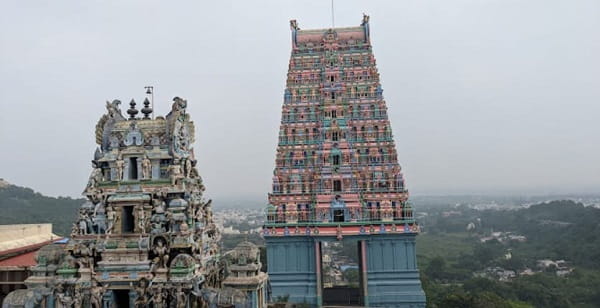
Tiruttani Temple Quick Overview
| Detail | Information |
| Temple | Arulmigu Subramaniya Swamy Temple (Tiruttani Murugan Temple) |
| Deity | Lord Murugan (Subramaniya/Kartikeya) with Valli and Deivanai |
| Location | Thanigai Hill, Tiruttani, Tiruvallur District, Tamil Nadu |
| Temple Hours | 5:30/5:45 AM – 9:00/9:30 PM |
| General Darshan Fee | Free |
| Special Darshan | ₹100 |
| VIP Darshan | ₹200 |
| Distance from Chennai | ~84–87 km |
| Steps to Climb | 365 (representing days of the year) |
Temple Timings: A Genuinely Long Daily Window
Tiruttani Temple opens between 5:30 and 5:45 AM depending on the source, and stays accessible until somewhere between 8:30 PM and 9:30 PM. Unlike many South Indian temples with a substantial midday closure, Tiruttani’s darshan generally runs fairly continuously through the day, though some internal rituals may briefly pause the queue at specific points.
On special festival days, the temple extends its hours further — one official source notes an additional window opening from 12:00 PM to 3:00 PM specifically to accommodate the higher devotee influx during major celebrations.
Best time for a peaceful darshan: Early morning right after opening tends to be calmest. The temple gets notably crowded on Karthigai month, festival days, and specifically on Tuesdays, Saturdays, Sundays, and public holidays — worth avoiding if a quiet, unhurried visit matters more to you than convenience.
Time to budget: Normal darshan waiting time typically runs 1 to 3 hours depending on the day, while Special Darshan cuts this down to roughly 20 to 30 minutes.
Darshan Ticket Types and Pricing
General darshan is completely free, and this remains how most pilgrims experience the temple, though be prepared for a longer wait during busy periods.
For faster access, two paid tiers exist:
- Special Darshan — ₹100 per person, purchased at the counter on arrival for same-day darshan
- VIP Darshan — ₹200 per person, offering the quickest entry, particularly useful for elderly visitors and families
All three darshan types lead to the same sanctum for blessings from Lord Murugan — the difference is purely in queue speed, not in the experience once you reach the deity.
Popular sevas beyond darshan:
- Abhishekam — ₹1,500, maximum two people per ticket, 30-40 minutes including darshan
- Kalyanotsavam — ₹4,000, performed daily at 10:00 AM, maximum two people per ticket
- Thanga Ther (Golden Chariot procession) — ₹3,500, performed daily at 7:00 PM, 45-60 minutes including darshan
Devotees believe performing Abhishekam specifically on a Tuesday helps reduce the malefic effects of Kuja Dosha, while Thiru Kalyanam is traditionally sought by those praying for a good spouse.
The 365 Steps: What to Expect on the Climb
Tiruttani Temple sits on Thanigai Hill, and the traditional route up involves climbing 365 steps, one symbolically representing each day of the year. That said, you don’t have to climb if walking isn’t practical — cars and autos can drive right up to the top of the hill, with parking available there directly.
If you do arrive by vehicle, the walk from the parking area is short: about 15-20 steps to the footwear deposit counter, roughly a one-minute walk from there to the temple entrance, and another 20-25 small steps to join the darshan queue itself. This makes the temple genuinely accessible even for elderly visitors or those who’d rather skip the full climb.
Dress Code and Practical Rules
Pilgrims are expected to wear traditional Indian attire — men typically in a dhoti or lungi, women in a saree or salwar kameez. Some sources note that any decent outfit is generally acceptable, so the enforcement here is less rigid than at some other major Tamil Nadu temples, but traditional dress remains the safer, more respectful choice.
Footwear must be removed entirely before entering the main temple premises, with deposit facilities available near the entrance. If you’re booking VIP darshan or any special seva at the temple office, carry a valid government-issued ID proof.
Location: Where Exactly Is the Temple?
Tiruttani Temple sits atop Thanigai Hill in Tiruttani, Tiruvallur district, Tamil Nadu, roughly 84 to 87 km from Chennai. It’s the fifth among the six sacred Arupadai Veedu abodes of Lord Murugan, and genuinely the only one located within the Greater Chennai Metropolitan Area, making it an easy day trip from the city rather than requiring a longer multi-day pilgrimage.
The temple complex features four precincts and a five-tiered gopuram, with two main shrines — one for Lord Murugan in his Shaktidhar form, and another dedicated to his consorts Valli and Deivanai. Its history traces back to the Sangam era, mentioned in the ancient Tamil text Tirumurugatruppadai written by Nakkeerar over two thousand years ago, back when the town was known as Kundruthoradal.
How to Reach Tiruttani Temple
By Rail: Trains run regularly from Chennai Central and Chennai Egmore railway stations directly to Tiruttani, making this genuinely the most convenient option for most Chennai-based pilgrims. From the railway station, auto-rickshaws are readily available to drop you at Sannathi Street, close to the temple base.
By Road: State government buses and private taxis connect Tiruttani to all major Tamil Nadu cities. If you’re driving yourself, the well-maintained road from Chennai makes this a comfortable day-trip option, especially given cars can drive right up to the hilltop parking area.
Frequently Asked Questions
Q: We have elderly parents who can’t manage 365 steps — is there really a way to avoid the climb entirely?
A: Yes, and this is genuinely one of Tiruttani’s most practical advantages over other hill temples. Cars and autos can drive directly up to the hilltop, where dedicated parking is available, meaning your parents only need to manage a short 15-20 step walk from the parking area to the footwear counter, not the full traditional climb.
Q: Is the ₹200 VIP Darshan significantly faster than the free general queue during a busy weekend?
A: Yes, quite significantly. General darshan waiting time typically runs 1 to 3 hours on busy days like Tuesdays, Saturdays, Sundays, or festival periods, while VIP Darshan cuts this down to roughly 20-30 minutes, making it genuinely worth the cost if you’re visiting during a peak period with limited time.
Q: We want to book Kalyanotsavam for a specific date — is same-day booking possible, or do we need to plan ahead?
A: Kalyanotsavam is performed daily at 10:00 AM with a maximum of two people per ticket, and based on how the temple structures its sevas, same-day counter booking is generally possible on regular days. During major festivals like Aadi Kirthigai or Skanda Sashti, though, it’s safer to inquire in advance given the significantly higher devotee volume during these periods.
Q: Why doesn’t Tiruttani perform the Soorasamharam ritual that other Murugan temples do?
A: According to temple tradition, Lord Murugan came to Tiruttani specifically to calm his anger after defeating the demon Surapadman at Tiruchendur, which is why this particular ritual — reenacting that battle — isn’t conducted here. Tiruttani’s spiritual character is instead centered on peace and tranquility, distinct from the more intense devotional energy associated with some of the other five Arupadai Veedu temples.