 By Saurav Mehra
 Most pilgrims completing the Jyotirlinga circuit describe something genuinely different happening at their twelfth and final stop — a stillness that arrives before they’ve even fully processed it. Grishneshwar is that final temple, sitting quietly beside the UNESCO-listed Ellora Caves in Maharashtra, and its origin story isn’t about power or conquest — it’s about a woman named Ghushma who chose forgiveness over revenge after unimaginable loss. If you’re planning this pilgrimage, whether to complete your own 12-Jyotirlinga journey or simply pair it with an Ellora Caves visit, here’s everything you genuinely need to know.
| Detail | Information |
| Temple | Grishneshwar Jyotirlinga Temple (12th and final Jyotirlinga) |
| Deity | Lord Shiva, also called Ghushmeshwar |
| Location | Verul village, Chhatrapati Sambhajinagar (Aurangabad) District, Maharashtra – 431102 |
| Daily Timings | 5:30 AM – 9:30 PM (sources vary on midday break) |
| General Darshan | Free |
| VIP/Special Darshan | ₹500, currently counter-based only |
| Abhishekam | Approximately ₹551, offline booking only |
| Distance from Ellora Caves | ~1–1.5 km |
| Nearest Airport | Aurangabad Airport (~30–35 km) |
Temple Timings: What to Actually Expect
Grishneshwar Temple generally operates from 5:30 AM to 9:30 PM, though sources genuinely disagree on whether there’s a midday closure — some describe continuous access throughout the day, while others report a break somewhere between 12:00 PM and 4:00 PM, or even a longer afternoon closure from 3:00 PM to 7:30 PM. Given this inconsistency, it’s worth building a buffer into your schedule rather than assuming continuous darshan, particularly if you’re timing a tight day trip around Ellora Caves.
During Shravan month (July-August), the temple genuinely extends its hours dramatically, opening as early as 3:00 AM and staying open until 11:00 PM to accommodate the massive devotional rush this sacred month brings. Maha Shivratri similarly sees extended, often night-long darshan hours with special rituals throughout.
Best time for a peaceful visit: Early morning between 5:30 AM and 8:30 AM on weekdays offers genuinely the calmest experience, well before both the temple crowds and the Ellora Caves tour groups arrive. October to February brings the most comfortable weather for the broader Verul-Ellora visit, while March to June gets genuinely hot, making early morning darshan a near-necessity rather than a preference during summer months.
Darshan: Free Entry, With a VIP Option Still Evolving
General darshan at Grishneshwar Temple is completely free, and this remains how the overwhelming majority of pilgrims experience the sanctum, standing in the same queue that moves steadily throughout the day.
VIP/Special Darshan costs approximately ₹500 per person, cutting your wait down to roughly 10-15 minutes compared to potentially much longer general queue times, especially during Shravan or Mahashivratri. That said, it’s worth being clear about the current booking reality: there is genuinely no fully official, consistently reliable online ticketing portal for VIP darshan at this temple as of now — bookings are still primarily handled at the temple counter itself, despite various third-party sites suggesting online options exist. If you’re planning around a VIP pass specifically, the safer approach is arriving early and arranging it in person rather than counting on securing one remotely in advance.
Abhishekam, the ritual offering of milk, curd, honey, bilva leaves, and holy water directly onto the Shiva Linga accompanied by Vedic mantras, costs approximately ₹551 per person and is currently booked exclusively offline at the temple counter. During Shravan month or Maha Shivratri specifically, arrive early if this ritual matters to you, since slots genuinely fill fast given the heavy crowds these periods draw.
The Legend of Ghushma: Why This Temple Represents Compassion
Understanding this story is genuinely essential to appreciating Grishneshwar beyond just its position as the final Jyotirlinga. According to the Shiva Purana, a devoted woman named Ghushma (also called Kusuma) performed an unwavering daily ritual — immersing 108 Shiva lingams into a sacred pond before praying with complete faith. Her sister-in-law Sudeha, consumed by jealousy over Ghushma’s son and her family standing, killed the child and disposed of the body in that very pond.
The following morning, despite this devastating loss, Ghushma continued her ritual exactly as always, her faith genuinely unshaken. Moved beyond measure by this extraordinary devotion, Lord Shiva appeared, restored her son fully to life, and offered her any boon she desired. In the story’s most remembered moment, Ghushma had every justification to ask for vengeance against the very woman who had killed her sleeping child. Instead, she asked Shiva to forgive Sudeha and to remain at that exact spot forever. Shiva granted both requests, taking the name Ghushmeshwar — later evolving to Grishneshwar, meaning “Lord of Compassion” — in her honor. This became the twelfth and final Jyotirlinga described in the Shiva Purana.
The small sacred pond (sarovar) near the temple today directly connects to this legend, and many pilgrims perform a ritual bath here before proceeding to darshan, consciously echoing the same waters where the story’s central miracle unfolded.
A Temple Rebuilt Twice by Maratha Royalty
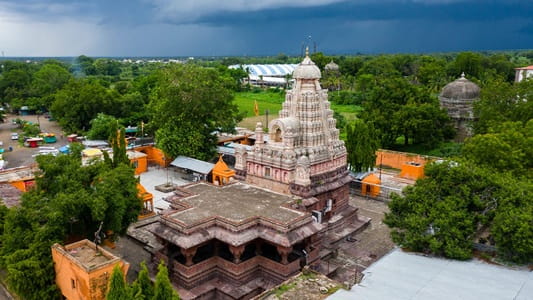
Grishneshwar’s physical structure carries genuine historical weight beyond its mythology. The temple was first restored in the 16th century by Maloji Bhosale, grandfather of Chhatrapati Shivaji Maharaj, and later rebuilt into its present form in the 18th century under Queen Ahilyabai Holkar — the same Maratha ruler credited with restoring several other Jyotirlinga sites across India during her reign.
The temple’s architecture reflects a genuinely distinctive Hemadpanthi style — a regional Maharashtra tradition characterized by sturdy local black basalt (and in places, striking red stone) construction with intricate but compact carving, notably different from the more elaborate Dravidian or North Indian Nagara styles found at many other Jyotirlinga sites. Built on a relatively compact 240 ft by 185 ft footprint, it’s genuinely recognized as the smallest of the twelve Jyotirlinga temples, featuring a five-tier shikhara and a Nandi statue guarding the entrance. The site is also listed as a protected national heritage monument by the Archaeological Survey of India.
Dress Code and Practical Rules
For men: Bare-chested entry is required within the sanctum sanctorum, following traditional temple custom. Some sources specifically note a preference for saffron-coloured dhoti, though modest traditional dress is the general expectation outside the innermost sanctum area.
For women: Modest, traditional Indian attire such as a saree or churidar is expected throughout the temple premises.
Electronics: Mobile phones and photography equipment are not permitted inside the temple, so plan to secure these before joining the darshan queue.
Footwear: Must be removed before entering the temple grounds.
Annadanam: Devotees can sponsor a meal offering for ₹1,500, with prasad meals served to visiting pilgrims daily as part of the temple’s charitable tradition.
Location: Where Exactly Is the Temple?
Grishneshwar Jyotirlinga Temple sits in Verul village, Chhatrapati Sambhajinagar (formerly Aurangabad) district, Maharashtra, roughly 30 km from Aurangabad city. Its position just over a kilometre from the UNESCO World Heritage Ellora Caves makes the two sites an almost inevitable single-day combination for most visitors — genuinely one of the most efficient heritage-plus-spiritual pairings in Maharashtra tourism.
How to Reach Grishneshwar Temple
By Air
Aurangabad Airport (Chhatrapati Sambhaji Nagar Airport, IXU) is the nearest, with distances cited between 30 and 35 km depending on the exact source. Taxis and app-based cabs are readily available outside the airport, with the drive typically taking 45 to 60 minutes.
By Rail
Aurangabad Railway Station is the primary rail gateway, roughly 30 km from the temple, with auto-rickshaws, state buses, private taxis, and shared cabs operating frequently toward Ellora and Verul. Daulatabad Railway Station serves as a nearby alternative for some routes.
By Road
The temple is well connected via NH-211 and state highways. MSRTC operates regular bus services between Aurangabad and the Ellora Caves vicinity, with the temple accessible via a short walk or auto ride from the local bus stand. Given how close Ellora Caves sits to the temple, most Ellora-bound cabs automatically stop here as part of the same trip.
Nearby Attractions Worth Combining With Your Visit
Ellora Caves, just over a kilometre away, forms the natural centerpiece of any Verul day trip, offering a genuine heritage-plus-spiritual half-day experience. Shree Bhadra Maruti Temple, a distinctive reclining Hanuman shrine, sits a short drive away in Khuldabad, while Khuldabad Heritage Walk takes in Sufi dargahs, historic lanes, and the Tomb of Aurangzeb for a layered historical stop. For those wanting a fuller day, Daulatabad (Devagiri) Fort pairs well as a strong afternoon addition alongside the temple and caves.
Frequently Asked Questions
Q1. We want to visit both Grishneshwar Temple and Ellora Caves in a single day — how should we sequence our visit?
Most experienced visitors recommend starting with early morning darshan at the temple, ideally by 5:30-6:00 AM, before the caves’ tour crowds pick up, then moving on to explore Ellora once the sun is higher. This sequence lets you experience the temple’s calmest window while still leaving the full day for the caves, which typically require several hours to explore properly.
Q2. We’re planning to book VIP darshan online in advance — is this reliable?
Based on multiple current sources, there isn’t yet a fully official, consistently dependable online booking portal for VIP darshan at Grishneshwar specifically — despite what some third-party travel sites suggest. The more dependable approach is arriving early and arranging your VIP pass directly at the temple counter, allowing 30-45 minutes of buffer time before your intended darshan slot.
Q3. We’re visiting during Shravan month — how much should we adjust our regular schedule?
Significantly. During Shravan, the temple genuinely extends hours to as early as 3:00 AM and as late as 11:00 PM to manage the heavy devotional crowds this month draws. If you’re planning to perform Abhishekam during this period specifically, arrive very early since booking slots fill up fast given the volume of pilgrims.
Q4. Given the conflicting information on midday closures, what’s the safest way to plan our arrival time?
Since sources genuinely differ on whether the temple observes a midday break (ranging from no break at all to closures as long as 3:00 PM–7:30 PM), the safest approach is planning your main darshan for either early morning (5:30-9:00 AM) or clearly into the evening (after 7:00 PM), avoiding the uncertain midday window entirely rather than risking arriving during a possible closure.
 Karan Singh