 By Saurav Mehra
 Standing at the exact point where the Bay of Bengal, the Arabian Sea, and the Indian Ocean meet, there’s a temple where the goddess never married — not out of choice alone, but because a sage’s cunning trick permanently altered her destiny. Kanyakumari Bhagavathy Amman Temple isn’t just India’s southernmost pilgrimage site; it’s genuinely one of the most storied Shakti temples in the country, famous for a diamond nose ring so bright it once caused a ship to wreck on the rocks nearby. Swami Vivekananda himself came here on his guru’s specific instruction before his famous meditation at the rock memorial just offshore. If you’re planning a visit, here’s exactly what you need to know.
Quick Overview
| Detail | Information |
| Temple | Kumari Amman Temple (Bhagavathy Amman Temple) |
| Deity | Devi Kanyakumari (Kumari/Bhagavathy Amman) |
| Location | Kanyakumari, Tamil Nadu (southernmost tip of India) |
| Morning Darshan | 4:30 AM–12:30 PM |
| Evening Darshan | 4:00 PM–8:00/8:30 PM |
| General Darshan | Free |
| VIP/Special Darshan | ₹20 |
| Special Abhishekam | ₹250 |
| Nearest Railway Station | Kanyakumari Railway Station (~1–1.5 km) |
Temple Timings: The Daily Schedule
Kanyakumari Temple opens at 4:30 AM and continues morning darshan until 12:30 PM, before closing for the afternoon and reopening at 4:00 PM through to around 8:00 or 8:30 PM in the evening. A standard darshan typically takes just 20 to 30 minutes given the temple’s efficient queue management.
During major festivals — Chitra Purnima, Navratri, Vaisakha, and the Kalabham festival — darshan hours extend beyond the usual schedule, with additional rituals performed throughout these periods.
Best time for a peaceful visit: October to February brings the most pleasant coastal weather for exploring Kanyakumari’s temples and viewpoints. Early morning right at the 4:30 AM opening offers the calmest darshan, well before the day’s tourist crowd arrives at this popular southern-tip destination.
Darshan Ticket: Free Entry, With an Affordable VIP Option
General darshan remains completely free for all devotees, and this is how most pilgrims and visitors experience the temple. For those wanting faster access, a VIP Darshan option is available for just ₹20 — genuinely one of the most affordable special-access tickets you’ll find at any major Indian temple.
For those wanting a more personal ritual, Special Abhishekam costs around ₹250. Interestingly, several visitor accounts note that on most days, the general darshan line moves quickly enough that few people actually opt for the paid VIP ticket — worth keeping in mind if you’re deciding whether it’s genuinely necessary for your visit.
A separate queue is available for physically challenged devotees, a genuinely helpful accommodation for elderly visitors or those with mobility concerns.
The Legend Behind the Eternal Virgin Goddess
Understanding this story genuinely deepens the visit. According to tradition, the demon Banasura had captured the devas and held them in cruel captivity, protected by a boon that he could only be killed by a virgin girl. In response to the devas’ desperate prayers, Goddess Parasakthi took the form of Kumari — a young virgin — specifically to defeat him.
As the story goes, Lord Shiva fell in love with Kumari, and preparations began for their celestial wedding. But Sage Narada, aware that Banasura could only be slain while the Goddess remained unmarried, devised a plan to prevent it. On the night of the wedding, as Shiva traveled from Suchindram toward Kanyakumari for the ceremony, Narada transformed into a rooster and crowed, falsely signaling that dawn had broken and the auspicious midnight muhurat had passed. Believing the sacred moment had slipped away, Shiva turned back — and the Goddess, left waiting, chose to remain unmarried forever after.
When Banasura later attempted to force marriage upon her, mesmerized by her beauty, she destroyed him with her Chakra Gadha, freeing the devas from his grip. In his final moments, Banasura begged for forgiveness, and the Goddess granted it — blessing the confluence waters at this very spot. This is precisely why devotees believe a dip in the waters here washes away one’s sins. According to further tradition, Sage Narada and Lord Parashurama then requested the Goddess to remain on earth in this form until the end of Kali Yuga.
The Diamond Nose Ring: Why the Eastern Door Stays Closed
This is genuinely one of the temple’s most talked-about features. The idol’s nose ring, said to be a diamond originally obtained from a King Cobra, shines with such striking brilliance that, according to popular legend, a sailor once mistook its glow for a lighthouse and steered his ship straight into the rocks nearby.
Because of this, the temple’s eastern door remains closed for most of the year, opened only five times annually on specific special occasions. If your visit happens to coincide with one of these rare openings, it’s genuinely worth witnessing, though most pilgrims experience the temple through its regularly used entrance without issue.
A Temple Documented Across Centuries
Kanyakumari Temple’s history stretches back through some of Hinduism’s oldest texts — it’s mentioned in both the Mahabharata and Ramayana, as well as in Sangam-era Tamil works like Manimekalai and Purananooru. Historical inscriptions found at the site reference Parantaka Pandya’s efforts to protect the temple from coastal erosion, alongside records tied to Kulottunga Chola I and Veera Udaya Marthanda Varma, reflecting the successive rule of the Pandyas, Cholas, Cheras, and Nayaks over this region across centuries.
The temple’s status is genuinely significant within Shakti worship — most sources count it among the Shakti Peethas, though the exact enumeration varies (some texts reference 51, others 108), a discrepancy common across different Shakti Peetha traditions rather than unique to this temple. It’s worth noting that local accounts vary too — some devotees associate the temple directly with the spot where part of Sati’s body fell, while others point to a smaller shrine roughly 200 metres away as the more precise Shakti Peetha location. Given this genuine local variation, it’s worth treating both accounts as part of the site’s layered devotional tradition rather than a single settled fact.
Dress Code: Strictly Enforced
This is genuinely one of the stricter dress codes among major Indian temples, and it’s consistently enforced.
For men: Bare-chested entry is required — shirts and vests must be removed before joining the darshan queue. Only a dhoti or pants is permitted below the waist; lungis are specifically not allowed according to several visitor accounts.
For women: A saree, churidar, salwar kameez, or long skirt with a top is acceptable. Short skirts alone (without appropriate coverage) should be avoided.
Strictly prohibited for everyone: Jeans, shorts, leather items, and mobile phones inside the temple. Photography and videography are also banned within the main sanctum, though you’re free to photograph the surrounding coastal views and temple exterior.
Nearby Attractions Worth Combining With Your Visit
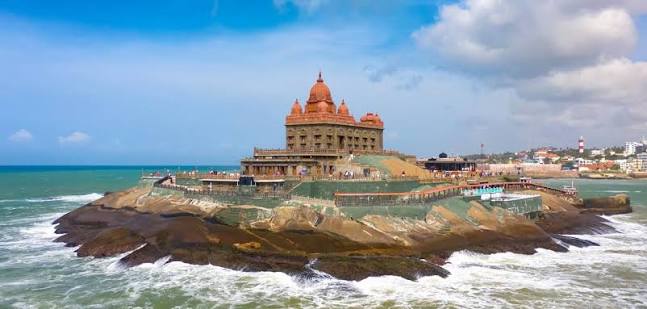
Kanyakumari’s location at India’s southernmost tip means several genuinely significant sites sit within easy reach. The Vivekananda Rock Memorial, just offshore, marks where Swami Vivekananda meditated in 1892 — notably, his own guru Sri Ramakrishna had specifically instructed him to first seek the blessings of this very goddess before his journey. The Thiruvalluvar Statue, Thanumalayan Temple in nearby Suchindram, Padmanabhapuram Palace, and Thirparappu Falls all make natural additions to a Kanyakumari trip.
Location: Where Exactly Is the Temple?
Kumari Amman Temple sits right at the southernmost tip of the Indian mainland, in Kanyakumari town, Tamil Nadu — precisely at the point where the Bay of Bengal, the Arabian Sea, and the Indian Ocean converge. This genuinely dramatic coastal setting adds a mystical quality that draws both devout pilgrims and curious travelers year-round.
How to Reach Kanyakumari Temple
By Rail
Kanyakumari Railway Station is remarkably close, just about 1 to 1.5 km from the temple, with direct trains connecting from various parts of India. Local transport easily covers the short remaining distance.
By Air
Thiruvananthapuram International Airport is the nearest, roughly 90-95 km away. From there, taxis and buses complete the onward journey to Kanyakumari.
By Road
The temple sits about 1 km from the Kanyakumari bus stop, easily reached by auto-rickshaw, taxi, or city bus from anywhere in the town. Kanyakumari is well connected by road to major South Indian cities, making it a natural final stop on a broader Tamil Nadu-Kerala pilgrimage circuit.
Frequently Asked Questions
Q1. We’re visiting specifically hoping to see the eastern door open — how do we know if our travel dates will coincide with one of the five annual openings?
The eastern door opens only on specific special occasions throughout the year, and these dates aren’t always widely publicized in advance for casual travelers. It’s genuinely worth checking with local temple authorities or your accommodation in Kanyakumari closer to your travel dates if witnessing this specific event matters to your trip.
Q2. My husband didn’t realize he’d need to go shirtless for darshan — is there somewhere nearby to store his shirt, or will this cause a problem at the gate?
This is a strictly enforced rule, so it’s genuinely worth knowing in advance rather than discovering it at the entrance. Most visitors simply hand their shirt to a family member waiting outside or use nearby storage facilities near the temple entrance — it’s a routine part of the experience here, not something that will hold up your visit significantly.
Q3. Is the ₹20 VIP darshan actually worth paying for, or is the free queue manageable most days?
Based on multiple visitor accounts, the general darshan queue moves quite efficiently on most regular days, completing within 20-30 minutes, so many visitors skip the VIP option entirely. It becomes more useful specifically during major festivals like Navratri or Vaisakha, when crowds swell considerably beyond a typical day.
Q4. We want to combine this temple visit with the Vivekananda Rock Memorial in the same morning — is that realistic given the temple’s timing?
Yes, this is genuinely one of the most common pairings for Kanyakumari visitors, given how close both sites sit to each other. Completing temple darshan during the early morning window before 12:30 PM, then taking the ferry to Vivekananda Rock Memorial afterward, works comfortably within a single morning without feeling rushed.
 Karan Singh