 By Saurav Mehra
 There’s a pillar inside Lepakshi Temple that genuinely doesn’t touch the ground — you can slide a piece of cloth clean underneath it, and even the engineers who’ve studied it haven’t fully cracked why the whole structure hasn’t collapsed. That’s just one of the mysteries waiting at this 500-year-old Vijayanagara marvel near the Andhra-Karnataka border. Add India’s largest monolithic Nandi, a footprint believed to belong to Sita herself, and a genuinely heartbreaking builder’s story, and Lepakshi becomes far more than a quick photo stop for anyone driving between Bengaluru and Anantapur. Here’s what you need to know before you go.
| Detail | Information |
| Temple | Sri Veerabhadra Swamy Temple (Lepakshi Temple) |
| Deity | Lord Veerabhadra (fierce form of Shiva), with Shiva and Vishnu shrines |
| Location | Lepakshi, Anantapur District, Andhra Pradesh – 515331 |
| Morning Darshan | 5:00 AM – 12:30/1:00 PM |
| Evening Darshan | 4:00 PM – 8:30 PM |
| Entry Fee | Free |
| Nearest Railway Station | Hindupur (~13.7–15 km) |
| Nearest Airport | Sri Sathya Sai Airport, Puttaparthi (~58 km) |
Temple Timings: What to Actually Expect
Lepakshi Temple’s darshan windows show genuine variation across different sources, which is worth flagging honestly rather than presenting a single confident schedule. Most detailed accounts consistently point to a morning session from 5:00 AM to somewhere between 12:30 PM and 1:00 PM, followed by a closure, then an evening session from 4:00 PM to 8:30 PM. A few sources describe a simpler continuous 6:00 AM to 6:00 PM schedule instead. Given this inconsistency, treat the temple as open roughly dawn to late evening with a midday break, and confirm the exact current timing locally on arrival rather than planning too tightly around a specific hour.
The temple also closes entirely during solar and lunar eclipses, and hours shift during major festivals like Shivaratri, Ugadi, and Kartika Purnima — worth checking ahead if your visit coincides with one of these.
A genuinely distinctive daily ritual worth knowing: the deity’s appearance itself changes through the day. In the morning, Lord Veerabhadra is worshipped in his youthful Bala Rupa form; by evening, he’s depicted transformed into a mustached hero. Devotees performing Abhishekam offer cloth, Sarkarai Pongal (a sweet rice pudding) as nivedhana, and receive Sadari blessing — touching the deity’s lotus feet, a tradition more commonly associated with Vishnu temples but observed here too.
Best time for a peaceful visit: October to March offers the most comfortable weather for exploring the temple’s extensive open courtyards. Early morning, right after the 5:00 AM or 6:00 AM opening, sees noticeably fewer visitors than the midday tourist rush that builds once day-trippers arrive from Bengaluru.
The Hanging Pillar: What Makes It Genuinely Puzzling
This is the single most talked-about feature at Lepakshi, and it’s worth understanding properly before you visit. Among the temple’s roughly 70 stone pillars, one — known as Aakasa Stambham — doesn’t fully rest on the ground. A visible gap exists between its base and the floor, genuinely wide enough that visitors can slide a thin cloth or sheet of paper straight through.
During British rule, an engineer reportedly attempted to uncover the mechanical secret behind this by trying to shift the pillar. He failed to move it meaningfully, but the attempt did dislodge it slightly from its original position — which is why the pillar sits exactly where it does today. Local belief holds that moving this particular pillar would cause all the others to shift too, a claim that continues to genuinely puzzle structural engineers who’ve examined it since.
Beyond the Pillar: The Temple’s Other Genuine Marvels
The Giant Nandi: Roughly a mile before the main temple sits India’s largest monolithic Nandi statue, carved from a single block of granite, measuring 27 feet long and 15 feet tall. It faces directly toward the Nagalinga inside the temple, with a small pond nearby adding to the setting.
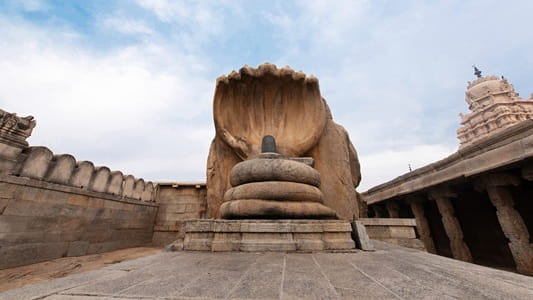
The Nagalinga: Inside the temple complex, a Shivalinga sits shaded by a monolithic seven-headed serpent — the largest such Nagalinga sculpture in India, carved entirely from a single stone. According to local legend, sculptors completed this remarkable carving in just one hour, working while their lunch was being prepared, a detail devotees still recount with genuine pride.
The Giant Footprint: A large footprint on the temple grounds, believed by most accounts to belong to Sita (with some versions attributing it to Hanuman instead), remains one of the site’s most visited curiosities.
The Kneeling Garuda: Just before the main entrance stands a large Garuda statue — Vishnu’s vehicle — depicted in a kneeling, devotional posture facing the inner sanctum, a striking blend of reverence and sculptural artistry.
Asia’s Largest Fresco: The ceiling of the Ardha Mandapa (ante-chamber) houses what’s recognized as Asia’s largest single fresco painting, measuring 23 by 13 feet, depicting the 14 avatars of Lord Shiva using a blend of mineral and vegetable pigments that have survived nearly five centuries.
The Heartbreaking Story Behind the Temple’s Construction
Understanding this history genuinely adds weight to your visit. The temple was built around 1530 CE by two brothers, Viranna and Virupanna Nayaka, who served as governors of Penukonda under Vijayanagara King Achyutaraya. Virupanna reportedly used funds from the state treasury to finance the temple’s construction.
When King Achyutaraya learned of this and grew furious, he ordered that Virupanna be blinded as punishment. According to tradition, upon hearing of this sentence, Virupanna blinded himself before the punishment could be carried out — an act of devastating self-sacrifice that’s remembered at the temple to this day, with certain wall marks locally associated with this tragic story.
Understanding Why the Name Means “Rise, Bird”
The name Lepakshi carries its own moving legend, separate from the temple’s construction. According to the Ramayana, this is where Jatayu, the mythical bird who tried to stop Ravana from abducting Sita, fell after a fierce battle, mortally wounded. When Lord Rama arrived in his search for Sita and found the dying Jatayu, he reportedly said “Le Pakshi” — Telugu for “Rise, O Bird” — and Jatayu rose one final time before dying in Rama’s arms. Rama himself is said to have performed Jatayu’s last rites, treating him as he would a brother.
Dress Code and Practical Rules
For men: Traditional dhoti and uthrayam, or a simple kurta-pyjama, shirt, and trousers are expected, particularly during aarti or puja participation.
For women: Saree with a chunni, salwar kameez, half-saree, or churidar are all appropriate. Jeans, t-shirts, shorts, and skirts are not permitted inside the temple.
Other rules: Leather bags and belts should be avoided. Bathing and wearing clean clothes before darshan is traditionally encouraged, and smoking, drinking, tobacco chewing, and spitting are all prohibited within the temple premises.
A genuinely useful note: unlike many major Indian temples, photography is permitted inside Lepakshi — worth knowing if you’re specifically hoping to capture the frescoes and hanging pillar. One source does mention mobile phones being discouraged inside, so it’s worth confirming this locally, since the guidance here isn’t entirely consistent across sources.
Festivals Worth Planning Around
Maha Shivaratri and Rathotsavam (the annual chariot festival) stand as the temple’s two most significant celebrations. During Rathotsavam, Lord Veerabhadra is paraded through Lepakshi town in a decorated chariot — a genuinely vibrant spectacle drawing devotees from across the region. Other observances include Karthika Deepam, Ugadi, Chandi Homam, and Vasantotsavam, each bringing extended rituals and heavier footfall than a regular visit.
Location: Where Exactly Is the Temple?
Sri Veerabhadra Swamy Temple sits on a low rocky hillock called Kurmasailam (meaning “tortoise hill” in Telugu) in Lepakshi village, Anantapur District, Andhra Pradesh, close to the Andhra-Karnataka border. The site’s history genuinely predates the Vijayanagara period — nearby locations linked to Mauryan King Ashoka’s edicts suggest the region’s significance dates back much further, with successive rule under the Satavahanas, Chalukyas, and Hoysalas before the Vijayanagara Empire finally annexed the area and drove major temple construction here.
How to Reach Lepakshi Temple
By Rail – Hindupur Railway Station is the nearest, roughly 13.7-15 km away, about a 20-minute journey. Penukonda Railway Station, around 35 km away, serves as a secondary option.
By Air – Sri Sathya Sai Airport in Puttaparthi is the nearest, about 58 km away, roughly 70-80 minutes by road. Kempegowda International Airport in Bengaluru, around 100-122 km away depending on the exact route, offers considerably broader flight connectivity for those arriving from further afield.
By Road – Lepakshi connects well by road to both Andhra Pradesh and Karnataka. Coming from Bengaluru, the standard route heads north, turning west at the Kodikonda checkpost on the Hyderabad highway (NH44). Regular private and government buses run through Hindupur, which serves as the main transport hub for reaching the temple, with buses and taxis covering the final stretch comfortably.
Frequently Asked Questions
Q1. We keep finding different temple timings online — what’s genuinely the safest way to plan our visit?
Given the real inconsistency across sources — some citing 5:00 AM to 1:00 PM with an evening reopening, others describing a simpler 6:00 AM to 6:00 PM continuous schedule — the safest approach is planning your visit for the morning window (before noon) and confirming the exact current schedule with local sources or the temple directly closer to your travel date, since Lepakshi doesn’t have a single, universally consistent published timing.
Q2. We’re driving from Bengaluru and want to combine this with the Sri Sathya Sai Airport route — does that make sense geographically?
Not particularly as a direct combination, since Puttaparthi’s airport sits roughly 58 km from Lepakshi in a different direction than the standard Bengaluru approach via Kodikonda checkpost. If you’re flying into Bengaluru specifically, the more straightforward route is driving directly north via NH44 rather than routing through Puttaparthi.
Q3. Is photography genuinely allowed inside, given how strict most Indian temples are about this?
Yes, based on multiple sources, photography is permitted inside Lepakshi Temple, which is genuinely less restrictive than many major shrines — worth taking advantage of if you want to capture the hanging pillar demonstration or the Ardha Mandapa’s massive fresco. That said, one source mentions phones being discouraged, so it’s reasonable to double-check with temple staff on arrival if you want full certainty.
Q4. We want to witness the hanging pillar’s famous “cloth test” — is this something we can do ourselves, or is it demonstrated by temple staff?
Visitors commonly slide a thin cloth or piece of paper underneath the pillar themselves to see the gap firsthand, and this remains a genuinely popular, hands-on part of most visits rather than something reserved for staff demonstration only. Just be respectful of the historic structure while doing so, given its age and cultural significance.
 Karan Singh