 By Saurav Mehra
 Unlike almost every other major temple in India, Sabarimala genuinely doesn’t stay open year-round — and that single fact catches more pilgrims off guard than anything else about this pilgrimage. Deep in Kerala’s Western Ghats forest, Lord Ayyappa’s shrine opens only on specific days tied to the Malayalam calendar, drawing millions during a handful of concentrated windows each year. Add the mandatory 41-day Vratham, the Irumudi Kettu bundle, and a strict virtual queue system, and Sabarimala becomes genuinely one of the most logistically demanding pilgrimages in the country. Here’s what you actually need to know before you plan this journey.
| Detail | Information |
| Temple | Sabarimala Sree Dharma Sastha Temple |
| Deity | Lord Ayyappa (Dharma Sastha) |
| Location | Sabarimala Hill, Pathanamthitta District, Kerala |
| Daily Timings (when open) | 5:00 AM – 10:00 PM |
| Temple Access | Only on specific days per Malayalam calendar |
| Darshan Fee | Free (Virtual Queue) |
| Daily Pilgrim Limit | Approx. 70,000–90,000 |
| Trek from Pamba | 5 km, 1.5–2 hours uphill |
Temple Timings: Why “Open” Doesn’t Mean Every Day
Sabarimala Temple operates on a genuinely unusual schedule compared to most Indian pilgrimage sites. On days it’s open, the temple runs from 5:00 AM to 10:00 PM, though these hours can extend during peak periods like Makaravilakku to accommodate the massive crowds.
The temple opens only during specific windows dictated by the Malayalam calendar:
- Mandala Pooja and Makaravilakku season — mid-November through mid-January, culminating in the Makara Jyothi celestial event
- Vishu — mid-April
- Utsavam and festival period — typically late March into early April, including Kodiyettam, Pallivetta, Painguni Uthram, and Aratt
- First five days of every Malayalam month — a shorter, regular monthly darshan window throughout the year
For the upcoming season, the Virtual Queue for Mandala-Makaravilakku opens for booking on November 1, 2026, with Makara Jyothi falling on January 14, 2027 — genuinely the single most crowded night of the entire season. Given how significantly demand spikes around this specific date, booking your slot the moment the queue opens is worth prioritizing if this is your target window.
Virtual Queue: Why Booking Is Genuinely Mandatory
This is the detail that catches unprepared pilgrims most often. During Mandala and Makaravilakku season specifically, entry to Sannidhanam without a Virtual Queue coupon simply isn’t permitted — this is strictly enforced at the Pamba checkpoint, where your ticket receipt gets verified before you’re allowed to begin the ascent.
Booking process: Visit sabarimalaonline.org, log in via mobile OTP (or register if you’re a first-time user), select your preferred date and time slot from the calendar, enter devotee ID details using a valid Aadhaar, Passport, or Voter ID, and download your e-ticket or QR code coupon. The booking itself is completely free — no cost for darshan, though nominal internet processing charges (around ₹10) may apply specifically for prasadam bookings like Aravana and Appam.
Checking availability: On the booking calendar, green slots indicate open availability, while red slots mean the day is fully booked. A single account can hold up to 10 active Virtual Queue coupons.
Limited offline booking exists at Pamba and Nilakkal counters, but these spot tickets are genuinely limited and not guaranteed during peak season — online booking remains the far more reliable route, especially if your travel dates are fixed.
The 41-Day Vratham and Irumudi Kettu
Understanding these two elements genuinely shapes the entire Sabarimala experience, and they’re not optional formalities for most pilgrims.
The Vratham involves 41 days of spiritual preparation before the actual pilgrimage — a strict vegetarian diet, wearing a black dhoti, observing celibacy, and daily prayers to Lord Ayyappa. Traditionally, this full 41-day observance is required specifically for first-time pilgrims, known as Kanni Ayyappan. Devotees who have already completed a previous Sabarimala pilgrimage may observe a shorter version, though it’s worth checking with your local Ayyappa temple for specific guidance on this. The Vratham is formally initiated by a Guru Swami — an experienced pilgrim who has completed the yatra before — typically at a local Ayyappa temple.
The Irumudi Kettu is a two-compartment cloth bundle that’s genuinely inseparable from the pilgrimage itself. It must be carried on the head throughout the climb — never placed on the ground — and prepared correctly under a Guru Swami’s guidance. Pilgrims without a properly prepared Irumudi Kettu are not permitted to climb to Sannidhanam, and this rule is strictly enforced at the Pamba checkpoint alongside the Virtual Queue verification.
Current Practice on Age Restrictions
This is worth addressing directly and factually. As per current temple tradition, women between the ages of 10 and 50 are restricted from Sabarimala darshan, while women below 10 and above 50 can book tickets and participate in the pilgrimage without restriction. This practice has been the subject of significant legal and public discussion in India in recent years, including proceedings before the Supreme Court, and remains an evolving and sometimes contested topic. For the most current, authoritative status on this specific matter, checking directly with the Travancore Devaswom Board or the official sabarimalaonline.org portal closer to your travel date is genuinely the most reliable approach, since practices and enforcement can shift.
Children below 5 years don’t require any Virtual Queue ticket booking at all.
The Trek: What the Climb Actually Involves
From Pamba base camp, pilgrims trek approximately 5 km uphill to reach the temple, typically taking 1.5 to 2 hours depending on your pace and the crowd density. No vehicles are permitted from Pamba onwards — every pilgrim, regardless of age or physical condition, completes this final stretch on foot.
Three route options exist for reaching Sabarimala:
- Traditional Pamba Route — roughly 4 km, starting near Kannimoola Ganapathi Temple
- Erumeli to Kalaketti Traditional Path — approximately 46 km, beginning at Dharmasasthavu Temple in Erumeli, a longer, more traditional pilgrimage route
- Vandiperiyar–Sathram–Pulmedu Route — around 16 km
The climb culminates at the Pathinettam Padi (18 Sacred Steps), a symbolic ascent representing spiritual progress. Pilgrims traditionally climb these final steps with their Irumudi Kettu balanced on their head, breaking coconuts as offerings along the way — a genuinely moving, physically demanding final stretch that most describe as the pilgrimage’s emotional peak.
Understanding Lord Ayyappa
The presiding deity, Lord Ayyappa, also known as Dharma Sastha, is believed to be the divine offspring resulting from the union of Shiva and Mohini — Vishnu’s female avatar — making him a genuinely unique figure who bridges the Shaiva and Vaishnava traditions within Hindu worship. He’s revered as a celibate deity, a symbol of discipline and dharma, and the pilgrimage itself reflects these values through the strict Vratham observance required beforehand.
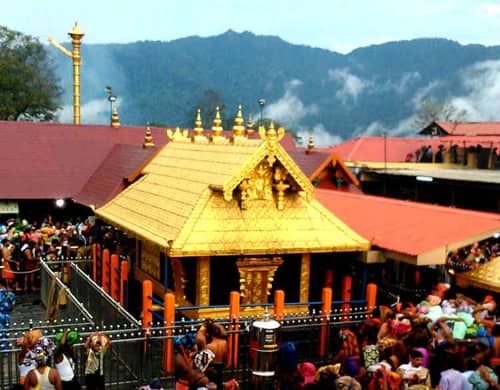
The main idol is crafted from Panchaloha (a blend of five metals), housed within a sanctum featuring a gold-plated roof and four golden finials. While exact archaeological dating remains uncertain, written documentation places the temple at over 200 years old, with oral tradition suggesting considerably older spiritual roots. Legend attributes the original installation of the idol to Sage Parashurama.
Location: Where Exactly Is the Temple?
Sabarimala Sree Dharma Sastha Temple sits atop Sabarimala Hill within the Western Ghats, in Pathanamthitta District, Kerala, surrounded by dense forest that genuinely limits year-round accessibility — part of why the temple’s restricted opening schedule exists in the first place. Nearby, Ponnambalamedu, roughly 4 km from the main temple, is where the Makara Jyothi celestial phenomenon appears in the night sky during Makaravilakku, drawing enormous crowds specifically to witness this moment.
How to Reach Sabarimala Temple
By Air
Cochin International Airport (COK) and Trivandrum International Airport (TRV) are the two nearest major airports, both offering reasonable onward connections toward the Pamba region.
By Rail
The closest railway stations are Chengannur, Kottayam, and Thiruvalla, from where taxis and buses continue the journey toward Pamba.
By Road
KSRTC buses, private vehicles, and taxis all connect to Pamba base camp, the starting point for the final trek. From Pamba, the journey continues entirely on foot, since vehicles aren’t permitted beyond this point.
Frequently Asked Questions
Q1. We’re planning our first Sabarimala pilgrimage — do we genuinely need to complete the full 41-day Vratham, or can we skip parts of it?
For first-time pilgrims (Kanni Ayyappan), the full 41-day Vratham is traditionally expected, including the vegetarian diet, celibacy, black dhoti, and daily prayers. It’s worth connecting with your local Ayyappa temple early to get initiated by a Guru Swami, since this preparation period needs to be planned well in advance of your actual travel dates.
Q2. The Virtual Queue for the 2026-27 season opens November 1, 2026 — how quickly does it typically fill up, especially around Makara Jyothi?
Given that Makara Jyothi (January 14, 2027) is consistently the most crowded single day of the entire Sabarimala season, slots for dates around this period tend to fill extremely fast once booking opens. If this specific date matters to your pilgrimage plans, being ready to book the moment the portal opens on November 1 genuinely improves your chances significantly.
Q3. We have an 8-year-old daughter traveling with us — does she need a Virtual Queue ticket, and are there any restrictions that apply to her?
Children below 5 years don’t need any Virtual Queue ticket booking at all. For your 8-year-old, since she falls below the age of 10, she would not be subject to the current age-based restriction that applies to women aged 10-50 — but she would still need her own Virtual Queue booking, so include her details when you register.
Q4. We’re not sure whether to attempt the traditional Erumeli route or the shorter Pamba route — how do we decide?
The traditional Erumeli to Kalaketti path, at roughly 46 km, is considerably longer and more physically demanding, typically chosen by pilgrims wanting the fuller traditional experience, often as part of their Vratham observance. The Pamba route, at just around 4 km before the final climb, is genuinely more practical for most first-time visitors or those with limited time, especially combined with the mandatory 5 km trek from Pamba itself to Sannidhanam.
 Karan Singh