 By Saurav Mehra
 Most people visiting Tamil Nadu’s Chola heritage circuit rush straight to Thanjavur’s Big Temple and skip its lesser-known sibling entirely — genuinely a mistake, since Gangaikonda Cholapuram was deliberately built by a Chola emperor to outshine his own father’s masterpiece. This UNESCO World Heritage temple sits in what was once the capital of an empire stretching across Southeast Asia, yet today it stands quietly in a small village, drawing far fewer crowds than Thanjavur while offering equally remarkable Dravidian architecture. If you’re planning to visit, here’s everything you need to know before making the trip.
| Detail | Information |
| Temple | Brihadeeswarar Temple, Gangaikonda Cholapuram |
| Deity | Lord Shiva |
| Location | Gangaikonda Cholapuram, Ariyalur District, Tamil Nadu |
| Daily Timings | 4:00 AM – 8:30 PM |
| Entry Fee | Free |
| UNESCO Status | World Heritage Site (1987), part of Great Living Chola Temples |
| Distance from Thanjavur | ~35 km |
| Distance from Trichy Airport | ~102 km |
Temple Timings: A Genuinely Long Daily Window
Brihadeeswarar Temple at Gangaikonda Cholapuram stays open from 4:00 AM to 8:30 PM daily, offering a considerably longer continuous window than many other South Indian temples with strict multi-session breaks. This remains an active place of worship, with four daily rituals performed alongside numerous annual festivals — it’s genuinely not just an archaeological monument, despite its historical significance.
Best time for a peaceful visit: November to March brings Tamil Nadu’s most pleasant weather with low humidity, ideal for spending time outdoors exploring the temple grounds. Given how much less crowded this site is compared to Thanjavur, even a midday visit tends to feel unhurried and quiet.
Entry: Free Darshan, No Ticket Required
General darshan at Gangaikonda Cholapuram Temple is completely free, with no entry fee or ticket system for regular visitors. Photography is allowed throughout the complex, though flash photography is restricted inside the sanctum area — a genuinely welcoming policy compared to many temples that prohibit photography entirely.
Given the site’s UNESCO status and active worship function, there’s no online booking system needed here — you simply arrive during the open hours and explore at your own pace.
The Story Behind the Name: A Son’s Ambitious Tribute
Understanding why this temple exists genuinely deepens the visit. Gangaikonda Cholapuram was founded by Rajendra Chola I, son and successor of the legendary Raja Raja Chola I, who ruled from 1014 to 1044 CE. After a series of successful military campaigns — including a decisive victory over the Pala Dynasty in the north — Rajendra I is said to have brought water from the Ganges River in a golden pot, pouring it into a massive reservoir he built called the Cholaganga (also known as Ponneri).
This remarkable act earned him the title “Gangaikondan” — the one who brought the Ganges — and the city he established took its name directly from this achievement: Gangaikonda Cholapuram, “the city of the Chola who took the Ganges.”
Rajendra I built this temple as a deliberate architectural echo of his father’s Brihadeeswara Temple in Thanjavur — partly as an act of devotion and gratitude to Shiva for his military successes, and partly as a bold declaration of his own imperial identity, distinct from his father’s capital. For over two centuries, this city served as the political and cultural heart of the Chola Empire, which at its peak extended influence across much of Southeast Asia.
What Happened to the City Afterward
This is a genuinely poignant part of the site’s history. As the Chola Empire eventually declined, Gangaikonda Cholapuram was repeatedly sacked and plundered by successive powers — the Pandyas, the Hoysalas, the Delhi Sultanate, and later the Vijayanagara Empire. The temple itself was damaged and neglected over centuries, losing much of its original grandeur, while the surrounding city was gradually reduced to what’s now a small village.
Remarkably, the temple itself survived this long decline, with the Archaeological Survey of India later restoring and preserving key features. In 1987, UNESCO recognized it as a World Heritage Site alongside the Brihadeeswara Temple in Thanjavur and the Airavatesvara Temple in Darasuram — together forming the Great Living Chola Temples.
Architecture Worth Taking Your Time Over
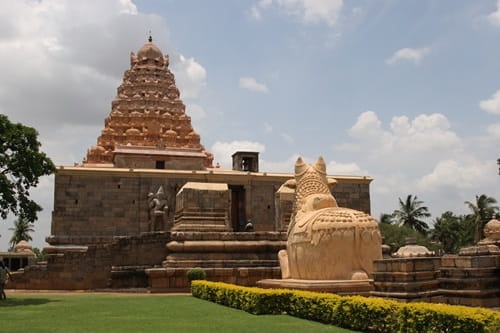
Built on a square plan facing east, the temple showcases classic Dravidian architectural style using granite, sandstone, and brick, with elaborate carvings throughout. The gopuram (gateway tower) rises roughly 30 metres across nine tiers, decorated with sculptures of Nandi, lions, elephants, makara (mythical sea creatures), and kirtimukha (protective face motifs) — genuinely intricate work worth pausing at before even entering the main complex.
The temple’s vimana (tower over the sanctum) stands as one of its most striking features, and the complex includes the mandapa (pillared hall), the sanctum itself, and the surrounding prakara (enclosure wall). Around the main sanctum sit five smaller shrines, along with a distinctive stone-carved Lion Well — a genuinely unusual water feature you won’t find replicated at most other Chola temples.
Sculptures worth specifically seeking out: the temple houses striking depictions of a dancing Shiva (Nataraja) and a serene Saraswati, along with a notable Ardhanareeswarar statue — the combined half-male, half-female form representing Shiva and Parvati as one being. A monolithic representation of the nine planetary deities (Navagraha) sits within the complex too, alongside bronze sculptures from the Chola era that give visitors a genuine sense of the period’s artistic sophistication.
The temple is also widely regarded as home to one of South India’s finest and largest Shivalingams — a detail that draws devotees specifically for darshan, separate from the historical and architectural interest the site attracts.
Practical Tips for Your Visit
Given the temple’s relatively remote location and limited nearby commercial development, it’s genuinely worth carrying a water bottle and packed lunch, since shops and restaurants around the immediate area are sparse. Light, breathable clothing is recommended given how much outdoor walking the visit involves across the temple grounds. Accessibility for wheelchair users is limited, so plan accordingly if traveling with anyone who has mobility concerns.
Location: Where Exactly Is the Temple?
Gangaikonda Cholapuram Temple sits in Ariyalur District, Tamil Nadu, in what remains of the once-grand Chola capital city. Its relatively quiet, less-visited setting compared to Thanjavur genuinely allows for unhurried exploration and photography without the crowds you’d encounter at more famous Chola sites.
Many travelers combine this temple with the nearby Airavatesvara Temple in Darasuram and the Sikkal Singaravelar Temple as part of a broader Chola heritage circuit, given their shared UNESCO recognition and relative proximity to one another.
How to Reach Gangaikonda Cholapuram Temple
By Rail – Thanjavur Railway Station is the nearest, roughly 35 km from the temple, with regular connections to major Tamil Nadu cities.
By Air – Tiruchirappalli International Airport is the closest, approximately 102 km away, making this more of a half-day excursion than a quick stop for those flying in.
By Road – The temple is well connected by road, with regular buses available from Kumbakonam and other nearby towns. Many visitors treat this as a half-day trip from Trichy or Thanjavur, combining it with other Chola-era sites in the same outing.
Frequently Asked Questions
Q1. We’re planning a half-day trip from Trichy — is it realistic to see both this temple and Airavatesvara Temple in one outing?
Yes, this is genuinely a popular and manageable combination, since both sites fall within the broader Great Living Chola Temples circuit and sit reasonably close to each other. Plan for a full day rather than a rushed half-day if you want unhurried time at both, especially given Gangaikonda Cholapuram’s limited nearby food options.
Q2. Is there an entry fee difference between visiting for darshan versus purely for historical/architectural interest?
No, entry is completely free regardless of your purpose for visiting, whether you’re there for religious darshan, historical exploration, or photography. The temple’s active worship status and its heritage significance coexist without any tiered ticketing system.
Q3. We’re traveling with an elderly family member who uses a wheelchair — how manageable is this site for them?
Accessibility here is genuinely limited, given the temple’s ancient stone construction and uneven surfaces typical of centuries-old monuments. It’s worth planning for extra assistance or a slower pace, and confirming specific accessibility concerns with a local guide or the temple staff before your visit if this is a significant factor for your group.
Q4. Why does this temple feel less crowded compared to Thanjavur’s Big Temple despite similar historical significance?
This largely comes down to accessibility and fame — Thanjavur city itself is a much larger, more frequently visited hub, while Gangaikonda Cholapuram sits in a quieter, more remote village setting. This actually works in visitors’ favor if you’re looking for a peaceful, unhurried architectural and spiritual experience without the tourist density of more famous sites.
 Karan Singh