 By Karan Singh
 There’s something genuinely different about standing at Thiruchendur during Viswaroopa Darshan — the sound of Bay of Bengal waves crashing behind you while priests reveal Lord Murugan at first light. This is the only one among the six sacred Arupadai Veedu shrines built directly by the sea, and that coastal setting alone makes the pilgrimage feel unlike any other Murugan temple visit. But between the early opening hour, multiple darshan tiers, and a genuinely strict dress code inside the inner sanctum, first-time visitors often arrive underprepared. Here’s everything sorted so your Thiruchendur trip goes exactly as planned.
| Detail | Information |
| Temple | Arulmigu Subramania Swamy Temple (Thiruchendur Murugan Temple) |
| Deity | Lord Murugan with Goddess Valli and Deivanai |
| Location | Thiruchendur, Thoothukudi District, Tamil Nadu |
| Daily Timings | 4:00 AM – 12:00 PM, 4:00 PM – 9:00 PM |
| Mottai Sanctum Hours | 6:00 AM – 6:00 PM |
| General Darshan Fee | Free |
| Special Darshan | ₹100 |
| Speed Darshan | ₹250 |
| Nearest Airport | Tuticorin Airport (~49 km) |
| Nearest Railway Station | Thiruchendur Railway Station (walking distance) |
Temple Timings: The Full Daily Schedule
Thiruchendur Murugan Temple opens its gates at 4:00 AM, genuinely one of the earliest openings among major South Indian temples, and the morning session runs through to 12:00 PM. Evening darshan then resumes at 4:00 PM and continues until 9:00 PM (sometimes listed as closing at 9:05 PM after final rituals).
Viswaroopa Darshan, running from 5:30 AM to 6:15 AM, marks the very first divine glimpse of Lord Murugan at dawn, and many devotees consider this the single most spiritually powerful moment of the entire day. Regular morning darshan for general devotees follows from 6:15 AM through to noon.
The Mottai — the inner sanctum where Lord Murugan’s idol stands in his standing posture holding the sacred Vel — has its own separate access window, from 6:00 AM to 6:00 PM daily. This is the holiest space within the complex, and reaching it involves a specific dress requirement men need to know before arriving.
During major festivals like Vaikasi Visakam, Panguni Uthiram, and Skanda Sashti, the temple may open as early as 1:00 AM to 3:00 AM for special pre-dawn rituals — always verify exact timings before planning a festival visit, since these shifts aren’t fixed year to year.
Best time for a peaceful darshan: The window between 4:00 AM and 6:30 AM sees significantly lighter crowds, making it ideal for senior citizens, families with young children, or anyone who simply wants an unhurried spiritual experience before the day’s rush builds.
Darshan Ticket Types and Pricing
General darshan at Thiruchendur is completely free, and this remains how the majority of pilgrims experience the temple, walking straight into the queue without any advance booking.
For those wanting faster or more personalized access, several paid tiers exist:
- Special Darshan — ₹100
- Speed Darshan — ₹250
- Abishekam — ₹1,500
- Golden Car Seva — ₹2,500
- Shanmugar Archanai — up to ₹5,000, the most elaborate personal ritual offering
Daily Abhishekam is performed at three fixed times — 6:15 AM, 10:30 AM, and 7:15 PM — so if a specific abhishekam slot matters to you, plan your arrival around one of these windows rather than assuming continuous availability.
Booking process: Visit the official Tamil Nadu HR&CE portal at tiruchendurmurugan.hrce.tn.gov.in, or the broader HR&CE booking section at tnhrce.gov.in. Select your preferred darshan or seva type, choose your date and time slot, complete payment, and carry the same photo ID used during booking on the day of your visit. Given how quickly slots fill during festivals like Vaikasi Visakam and Skanda Sashti, completing your booking 4 to 7 days in advance is genuinely worth doing rather than risking availability closer to your travel date.
Dress Code Inside the Mottai Sanctum
This is the detail that catches the most first-time male visitors off guard. Men are required to remove their shirt and vest before entering the darshan line for the Mottai sanctum — a tradition strictly and consistently observed here, not an occasional enforcement. A dhoti or pants below the waist is acceptable, but the upper body must stay bare for this specific inner sanctum area.
Women can wear traditional clothing such as sarees or salwar kameez. Jeans are generally not permitted for either gender inside the temple’s sacred spaces.
Location: Where Exactly Is the Temple?
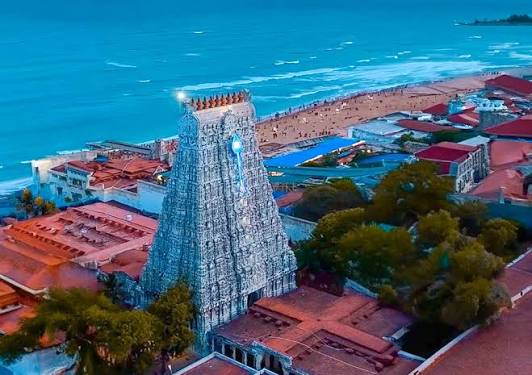
Thiruchendur Murugan Temple sits directly on the shores of the Bay of Bengal in Thoothukudi District, Tamil Nadu — the only one of the six Arupadai Veedu temples positioned right by the sea, unlike the other five, which sit inland or on hilltops.
What makes this location genuinely distinctive is how the ocean becomes part of the ritual experience itself. Evening pooja with waves audible in the background, and the temple’s Deeparadhana lamp ceremony against a sea backdrop, are experiences visitors consistently describe as staying with them long after the trip ends. The sanctum sits slightly below ground level, creating an unusually intimate atmosphere compared to most elevated Murugan shrines.
How to Reach Thiruchendur Murugan Temple
By Air
Tuticorin Airport is the nearest, about 49 km from the temple, well connected to major Indian cities including Chennai, Bangalore, and Hyderabad. From the airport, taxis and cabs cover the remaining distance comfortably.
By Rail
Thiruchendur Railway Station sits within walking distance of the temple itself, making train travel genuinely one of the most convenient options for pilgrims. Regular trains connect Thiruchendur to Tirunelveli, Madurai, and Chennai, serving both short and long-distance travelers.
By Road
Frequent state buses run from Tuticorin, Tirunelveli, and surrounding towns, and the roads leading into Thiruchendur are well-maintained and clearly marked, making self-driving a comfortable option too, especially for families traveling together.
Once you’ve completed darshan, many pilgrims combine the visit with a ritual sea bath at Thiruchendur Beach right nearby, along with nearby sites like Valli Cave and Panchalankurichi Fort if time allows.
Frequently Asked Questions
Q1. My husband forgot that shirts aren’t allowed in the Mottai — is there somewhere to store it nearby?
Yes, this comes up often enough that arrangements exist near the sanctum entrance for exactly this situation — either handing belongings to a family member waiting outside or using nearby storage facilities. It’s still smarter to plan for this in advance rather than discovering it right at the queue.
Q2. We’re visiting for Skanda Sashti — how much earlier should we expect the temple to open?
During major festivals like Skanda Sashti, the temple can open as early as 1:00 AM to 3:00 AM for special pre-dawn rituals, considerably earlier than the standard 4:00 AM opening. Since this shifts depending on the specific festival calendar each year, confirm exact timings on the official HR&CE portal shortly before your travel date rather than assuming the regular schedule applies.
Q3. Is the ₹250 Speed Darshan genuinely faster than the free general queue, or is it marginal during busy periods?
During regular weekdays outside festival season, the difference may feel modest since general darshan itself moves reasonably well. During Vaikasi Visakam, Panguni Uthiram, or Skanda Sashti, though, Speed Darshan genuinely saves substantial time, since free-queue waits during these peak periods can stretch considerably longer than a typical day.
Q4. Can we do the ritual sea bath at Thiruchendur Beach before or after darshan — does timing matter?
Most pilgrims prefer doing the sea bath first thing in the early morning, both for the calm, uncrowded beach atmosphere and because it’s traditionally treated as a purification step before entering the temple. If your schedule only allows for after darshan, that’s completely fine too — there’s no fixed sequence required, just personal and traditional preference favoring the morning.