 By Saurav Mehra
 Most people know Srirangapatna as the island fortress where Tipu Sultan made his last stand against the British in 1799. Far fewer realize that centuries before Tipu ever set foot here, this same island was already one of South India’s most sacred Vishnu pilgrimage sites — and genuinely, the very first of a rare three-temple circuit along the Kaveri River. Sri Ranganathaswamy Temple here is called Aadi Rangam, “the first Ranga,” and tradition holds that visiting all three sister temples in this sequence on the same day grants moksha. If you’re planning a Mysore trip, adding this temple genuinely deepens the visit beyond just Tipu’s palace and tomb.
| Detail | Information |
| Temple | Sri Ranganathaswamy Temple (Aadi Rangam) |
| Deity | Lord Ranganatha (reclining Vishnu on Adisesha) |
| Location | Srirangapatna, Mandya District, Karnataka – 571438 |
| Daily Timings | 7:00 AM – 1:30 PM, 4:00 PM – 8:30 PM |
| Entry Fee | Free |
| Distance from Mysore | ~17–20 km |
| Distance from Bangalore | ~125–127 km |
| Nearest Railway Station | Srirangapatna Station (~280–500 m from temple) |
Temple Timings: A Consistent Daily Schedule
Sri Ranganathaswamy Temple in Srirangapatna follows the same schedule every single day of the week — morning darshan from 7:00 AM to 1:30 PM, and evening darshan from 4:00 PM to 8:30 PM. Unlike some larger pilgrimage temples with complex multi-session breaks, this schedule stays consistent across Monday through Sunday, genuinely simplifying your visit planning.
Best time for a peaceful visit: Early morning right at the 7:00 AM opening offers the calmest atmosphere, especially useful if you’re also planning to combine your trip with the nearby Ranganathittu Bird Sanctuary, which itself is best visited in the cooler morning hours. Weekdays are noticeably quieter than weekends, when the temple draws heavier footfall from both Mysore and Bangalore day-trippers.
Darshan: Free Entry to This Historic Shrine
Entry to Sri Ranganathaswamy Temple, Srirangapatna is completely free, with no ticketed darshan system or paid special-entry category — every devotee joins the same queue for darshan of Lord Ranganatha.
Given the temple’s status as an ASI-protected monument of national importance alongside its function as an active place of worship, there’s no online booking portal for darshan here. This remains a genuinely straightforward, walk-in pilgrimage experience compared to some of Karnataka’s larger, more heavily ticketed temples.
Why This Temple Is Called “Aadi Rangam”
This is genuinely the most fascinating thing about Srirangapatna Temple, and it’s worth understanding before your visit. Sri Ranganathaswamy Temple here is one of the five Pancharanga Kshetras — alongside Srirangam (Tamil Nadu), the Sarangapani Temple in Kumbakonam, Appakudathan Temple in Trichy, and Parimala Ranganathaswamy Temple in Mayiladuthurai — but within Karnataka specifically, it holds a distinct three-temple significance along the Kaveri’s course.
According to tradition, three Ranganatha temples sit along the Kaveri River in sequence: Srirangapatna is Aadi Rangam (the first), Shivanasamudram is Madhya Rangam (the middle), and Srirangam in Tamil Nadu is Anthya Rangam (the final). Devotees who visit all three on a single day are believed to attain moksha — a genuinely rare and specific pilgrimage tradition that makes Srirangapatna the starting point of this sacred sequence rather than just another isolated temple stop.
Understanding the Deity and Temple Layout
The main sanctum houses Lord Ranganatha in his reclining form, resting on the seven-headed serpent Adisesha — considered one of the largest idols of Vishnu depicted in this posture anywhere. Goddess Lakshmi is shown at the Lord’s feet, while Goddess Ranganayaki is worshipped as the temple’s principal female deity in her own separate shrine.
Beyond the main sanctum, the complex houses several additional shrines dedicated to Srinivasa, Rama, Narasimha, Sudarshana, Panchamukha Anjaneya, and Gopalakrishna — giving devotees a genuinely fuller spiritual circuit within one visit.
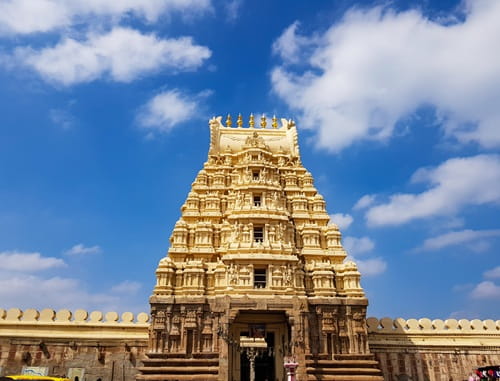
Architecture worth noticing: The temple entrance features four majestic pillars carved with 24 forms of Lord Vishnu, a hallmark of Hoysala craftsmanship that reflects the dynasty’s deep appreciation for detailed artisan work. The prakaram (surrounding corridor) is painted with an extensive array of mythological scenes, while the gopuram’s intricate carvings show clear Vijayanagara influence — together making this temple a genuine study in layered South Indian architectural history spanning multiple dynasties.
A History Tied to Empires and Emperors
Historical records trace the temple’s construction to 894 AD, when Thirumalaraya, a vassal under the Western Ganga dynasty, built upon an already-existing shrine at this site. In the early 12th century, Hoysala King Vishnuvardhana gifted the entire village of Srirangapatna to the revered Vaishnava saint Ramanujacharya as an agraharam (a settlement dedicated to learning and worship). An inscription from Hoysala King Veera Ballala II, dated 1210 CE, documents significant renovations carried out during that era.
What makes Srirangapatna’s history genuinely distinctive among South Indian temples is its later connection to two of India’s most notable historical rulers — Hyder Ali and Tipu Sultan both held this temple in high esteem, even as they built their fortress capital around it. The Katorotsava festival, still celebrated today, was actually introduced by Hyder Ali himself in 1774, held during the month of Dhanurmasa (December), with the royal family traditionally performing a special pooja on the festival’s ninth day — a genuinely unusual example of a Muslim ruler personally patronizing a Hindu temple’s festival calendar.
According to local legend, the River Kaveri herself performed penance to Lord Ranganatha at this exact site, and pleased with her devotion, he granted her greater holiness than even the Ganges, while also declaring Srirangapatna itself a sacred Kshetra.
Dress Code and Entry Rules
For men: Shirt and pants, or traditionally, a dhoti with a shirt.
For women: Saree, half-saree, or chudidhar.
Non-Hindu visitors: As at several major South Indian Vaishnavite temples, non-Hindus are generally not permitted inside the inner sanctum, though access to the outer temple complex remains open to all visitors.
Festivals Worth Planning Around
Katorotsava (December) stands out as the temple’s most historically distinctive celebration, given its origins under Hyder Ali’s patronage and the continued royal family participation in its rituals.
Bangarada Garudotsava, Sriranga Jayanti, Sudha Poornima, and Uyyalotsava (a swing festival for the deity) round out the temple’s broader annual festival calendar, each drawing pilgrims specifically for that occasion’s unique rituals.
Location: Where Exactly Is the Temple?
Sri Ranganathaswamy Temple sits within the Srirangapatna Fort, on an island formed by the Kaveri River, in Mandya District, Karnataka — the very town from which the temple takes its name. This positioning inside the historic fort complex means a temple visit naturally sits alongside some of Karnataka’s most significant historical sites, including Tipu Sultan’s Summer Palace (Daria Daulat Bagh) and his tomb at Gumbaz, both within easy reach.
Nearby attractions worth combining with your visit: Ranganathittu Bird Sanctuary, Jumma Masjid (Masjid-e-Ala), Karighatta, Nimishamba Temple, Krishnaraja Sagar (KRS) Dam, and Kunti Betta — genuinely making Srirangapatna a full-day destination rather than a quick temple stop.
How to Reach Srirangapatna Temple
By Rail
Srirangapatna Railway Station sits directly behind the temple complex, with distances cited anywhere from 280 to 520 metres — essentially a short, comfortable walk. Mysore Junction, roughly 17-20 km away, offers considerably broader connectivity to major Indian cities, and several express trains between Bangalore and Mysore also stop directly at Srirangapatna itself.
By Air
Mysore’s Mandakalli Airport is the nearest, roughly 32 km away, though flight options here remain limited. Kempegowda International Airport in Bangalore, about 168 km away, offers far more extensive domestic and international connectivity, with a road journey of roughly 3 hours to reach Srirangapatna.
By Road
From Bangalore, the distance is approximately 125-127 km via the Bangalore-Mysore Expressway (NH275), taking about 2.5 to 3 hours by car. KSRTC operates frequent bus services — roughly every 30 minutes — connecting Bangalore’s Majestic bus station to Srirangapatna, with options ranging from economical Karnataka Sarige services to more comfortable Volvo Airavat buses (note that luxury buses may not enter the Srirangapatna bus stand directly, so request your stop from the conductor). From Mysore, it’s a much shorter 17-20 km trip, with frequent local buses connecting the two.
Frequently Asked Questions
Q1. We want to complete the full three-temple Rangam pilgrimage in one day — is that realistic starting from Bangalore?
Given that Srirangapatna, Shivanasamudram, and Srirangam (Tamil Nadu) are spread across a considerable distance, attempting all three in a single day from Bangalore is genuinely demanding and not typically how devotees approach this pilgrimage. Most treat it as a multi-day journey, visiting Srirangapatna first as the natural starting point given its proximity to Mysore, before continuing on to the other two temples over subsequent days.
Q2. We’re combining this with Tipu Sultan’s Summer Palace and Ranganathittu Bird Sanctuary — how should we sequence our day?
Given the temple’s morning-to-1:30 PM session, starting with darshan right at 7:00 AM works well, followed by Ranganathittu Bird Sanctuary (best visited in cooler morning hours for bird activity), and rounding off with Daria Daulat Bagh and Gumbaz in the early afternoon before the temple’s evening session reopens at 4:00 PM if you want a second visit.
Q3. Is there anywhere to stay directly at the temple, or do we need to book accommodation separately?
The temple itself offers no accommodation facilities for devotees, so you’ll need to book a hotel separately in Srirangapatna town, where several options with online booking are available, or stay in nearby Mysore, which offers considerably more choice roughly 17-20 km away.
Q4. We’re not Hindu but want to appreciate the temple’s architecture and history — will we be able to visit meaningfully?
Yes, while entry into the inner sanctum is generally reserved for Hindu devotees, the outer temple complex remains open to all visitors, including the impressive Hoysala-carved entrance pillars, the mythologically painted prakaram corridors, and the Vijayanagara-style gopuram — genuinely enough architectural and historical richness to make the visit worthwhile even without sanctum access.
 Karan Singh