 By Karan Singh
 If you’re planning a Tirupati trip and someone’s told you “don’t skip Kalahasti,” they’re not exaggerating. This is the temple devotees specifically travel to when they’re dealing with Rahu-Ketu dosha, Sarpa dosha, or just feel like something in life is stuck without explanation. Unlike most Shiva temples that shut down during eclipses, Kalahasti stays open — a detail that tells you how this place operates differently from the rest. If you’re heading here after Tirumala or making it a standalone trip, knowing the timings, ticket options, and route in advance turns what could be a confusing half-day detour into a smooth, meaningful visit.
Temple Timings: What the Day Actually Looks Like
Sri Kalahasti Temple opens at 5:30 AM and functions through the day until around 9:00 PM, though a few sources note closing as late as 9:30 PM — worth a quick local check if you’re planning a very late evening visit.
General darshan runs from 6:00 AM to 9:00 PM, with a short afternoon break typically between 12:30 PM and 1:30 PM for internal rituals. Some visitor guides break the day into three blocks — morning (6:00 AM–1:00 PM), afternoon (3:00 PM–6:00 PM), and evening (6:30 PM–9:30 PM) — so don’t be surprised if the gates feel quieter or momentarily restricted around midday.
Here’s what genuinely sets this temple apart: it remains open even during solar and lunar eclipses. Most Shiva temples close their doors during these periods, but Kalahasti doesn’t — a tradition rooted in its own unique legends, and something devotees specifically travel here to experience during eclipse dates.
Best time for a peaceful darshan: Early morning between 6:00 AM and 8:00 AM sees the shortest queues. On a regular weekday, most pilgrims complete darshan within 30 to 60 minutes.
Rahu Ketu Pooja Timings
This is the single biggest reason most people travel to Kalahasti. The pooja runs daily from 6:00 AM to 6:00 PM, and unlike many other doshha-nivarana rituals elsewhere, you don’t need to submit horoscope details to participate — you can walk in and book directly.
If you want the ritual at its most potent, try to time it around the day’s Rahu Kalam window, which shifts daily based on the Hindu calendar — worth checking a day ahead rather than guessing on arrival.
Darshan Ticket Types and Prices
General darshan is free, and children below 12 don’t need a ticket at all.
For those who want a faster or more exclusive experience, the temple offers paid options:
- Antharalaya Darshanam (closer inner-sanctum view) — around ₹500
- Standard special seva ticket — around ₹500, with some categories starting from ₹150
- Couple ticket — around ₹2,500
- Premium couple ticket — around ₹5,000
One package worth knowing about is the ₹1,000 combo ticket, which includes all pooja materials plus an exclusive darshan and archana — meaning you don’t need to buy anything separately from the stalls outside, which several visitors flag as overpriced and unnecessary.
Booking process:
Tickets can be booked online through the official AP Endowments portal (aptemples.ap.gov.in) — select Srikalahasti Devasthanam, choose your seva type, fill in pilgrim details, and pay via UPI, card, or net banking. Counter booking is also available on the same day for most sevas, though online booking is recommended during weekends and festival periods like Maha Shivaratri, when the temple sees well over 3 lakh devotees in a single day.
Location: Where Exactly Is the Temple?
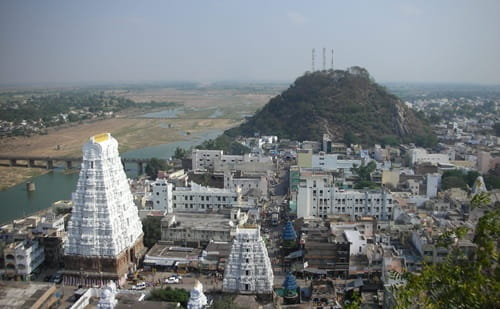
Sri Kalahasti Temple sits on the banks of the Swarnamukhi River in Srikalahasti town, Chittoor district, Andhra Pradesh — roughly 36 km from Tirupati. The temple is often called Dakshina Kailasam, or the “Kailash of the South,” and represents the Vayu (air) element among the five Pancha Bhoota Sthalams dedicated to Shiva.
What makes the setting genuinely striking is how the temple’s location on the riverbank ties directly into its founding legend — the spider, snake, and elephant who worshipped here are said to have done so right along these banks, which is why the town carries their names in its own.
How to Reach Sri Kalahasti Temple
By Air
Tirupati Airport (Renigunta) is the nearest airport, about 36 to 40 km away, roughly a 45-minute to one-hour drive. It’s well connected to major Indian cities including Chennai, Bengaluru, Hyderabad, Mumbai, and Delhi.
By Rail
Sri Kalahasti has its own railway station, just about 2 km from the temple, making this genuinely the most convenient way to arrive. It’s connected to Chennai, Bengaluru, Hyderabad, and Coimbatore through several regular express trains.
By Road
From Tirupati, it’s about a 45-minute to one-hour drive covering roughly 36–37 km, with regular buses and taxis running the route throughout the day. From Chennai, expect around 116–140 km depending on the route taken, translating to roughly 2.5 to 3 hours by road. If you’re coming from Bengaluru, it’s a longer haul at about 250–270 km.
Many pilgrims combine this trip with Kanipakam Temple, located about 110 km further from Kalahasti — worth planning as a separate day if you want unhurried darshan at both, rather than rushing through in one stretch.
Frequently Asked Questions
Q1. I’m visiting right after Tirumala darshan — will I have enough time for Kalahasti the same evening?
It depends on when you finish at Tirumala. Since Kalahasti’s general darshan runs till 9:00 PM and the drive from Tirupati is under an hour, you can manage it the same evening if you leave Tirumala by early afternoon. Cutting it too close on a weekend, though, means arriving into a longer evening queue.
Q2. Do I need to carry my horoscope for Rahu Ketu Pooja?
No. The temple allows devotees to perform Rahu Ketu Pooja without submitting any horoscope details — you can book directly at the counter or online and participate without that documentation.
Q3. Is the ₹1,000 combo ticket actually worth it, or is general darshan enough?
If you specifically want the archana and a closer darshan without haggling over pooja items outside, the ₹1,000 ticket is convenient since materials are included. But if you’re simply here for a standard darshan of the Vayu Lingam without additional rituals, general darshan works fine and costs nothing.
Q4. We’re travelling with elderly parents — is the inner sanctum area manageable for them?
Some visitors note the main sanctum is dim and can feel congested, so it’s worth planning an early morning slot (6:00–8:00 AM) when movement inside is easier and there’s less pushing through narrow passages. Avoid weekend afternoons if mobility is a concern.